High-Carbon Content Knives Everything You Need to Know
炭素鋼
Ginza Steel · Knife Knowledge Series
High-Carbon Content Knives
Everything You Need to Know
高炭素鋼 · Kōtanso-kō
Everything You Need to Know
What carbon content actually means, how it shapes your blade's performance, and how to care for a high-carbon knife the right way.
The Foundation of Japanese Blade-Making
Carbon content is one of the most important factors in how a kitchen knife performs. It governs hardness, edge retention, sharpening behaviour, and how the blade ages over time. Understanding it helps you choose the right knife — and take care of it properly.
What Does "High Carbon Content" Mean?
Carbon content refers to the percentage of carbon present in a steel alloy. In knife blades, steels with more than 0.6% carbon are generally classified as high-carbon steels. Premium Japanese knives often use steels ranging from 0.8% to over 1.2% carbon — well above this threshold.
Carbon is what gives steel its hardness potential. The higher the carbon content, the harder the steel can be made through heat treatment (hardening and tempering). Harder steel holds a sharper edge for longer — but it also requires more skill to sharpen and more care to maintain.
"Carbon is the element that transforms iron into a blade worth using. Too little and it cannot hold an edge. Just enough and it becomes something remarkable."
Most Western kitchen knives use steels with 0.3–0.5% carbon. Traditional Japanese knives — especially those made from Shirogami (White Steel) or Aogami (Blue Steel) — typically sit at 1.0–1.4% carbon. This is a meaningful difference, and it is why Japanese knives are known for their extraordinary sharpness.

Carbon Steel Care
Camellia oil — the traditional choice for protecting high-carbon steel knife blades
Camellia oil — the traditional choice for protecting high-carbon steel knife blades
How Carbon Content Affects Performance
The relationship between carbon content and knife performance is direct and significant. Here is what changes as carbon increases:
| Property | High Carbon (1.0%+) | Stainless / SG2 | Low Carbon (<0.5%) |
|---|---|---|---|
| Max Hardness (HRC) | 62–65+ | 60–64 | 52–56 |
| Sharpness Potential | Exceptional — finest edge achievable | Excellent | Moderate |
| Edge Retention | Very good to outstanding | Outstanding | Low |
| Ease of Sharpening | Responds quickly to whetstones | Requires skill and time | Easy but dulls fast |
| Rust Resistance | Reactive — needs care | Excellent stainless | Moderate |
| Patina Development | Yes — natural protection | None | Light |
| Best Use | Professional kitchens, enthusiasts | Daily professional use | Casual, low-maintenance |
Sharper Edge
Higher carbon allows a finer grain structure, enabling a more acute edge angle and a keener cutting feel than lower-carbon steels.
Longer Edge Life
Harder steel wears more slowly, meaning fewer trips to the whetstone between sessions. A well-maintained carbon blade stays sharp through demanding use.
Responsive to Sharpening
High-carbon steels like White #2 respond quickly to whetstones. Even a 1000-grit stone brings back a working edge in minutes.
Living Patina
Reactive carbon steel develops a dark patina with use. This iron-oxide layer actually protects the blade and reduces ongoing reactivity.
Needs Moisture Control
Without chromium, high-carbon steel will rust if left wet. A quick dry after use is all it takes to prevent surface oxidation.
Rewarding to Use
Many chefs find high-carbon knives more intuitive — the feedback through the blade is cleaner, and the cut more precise than stainless equivalents.

Proper Care
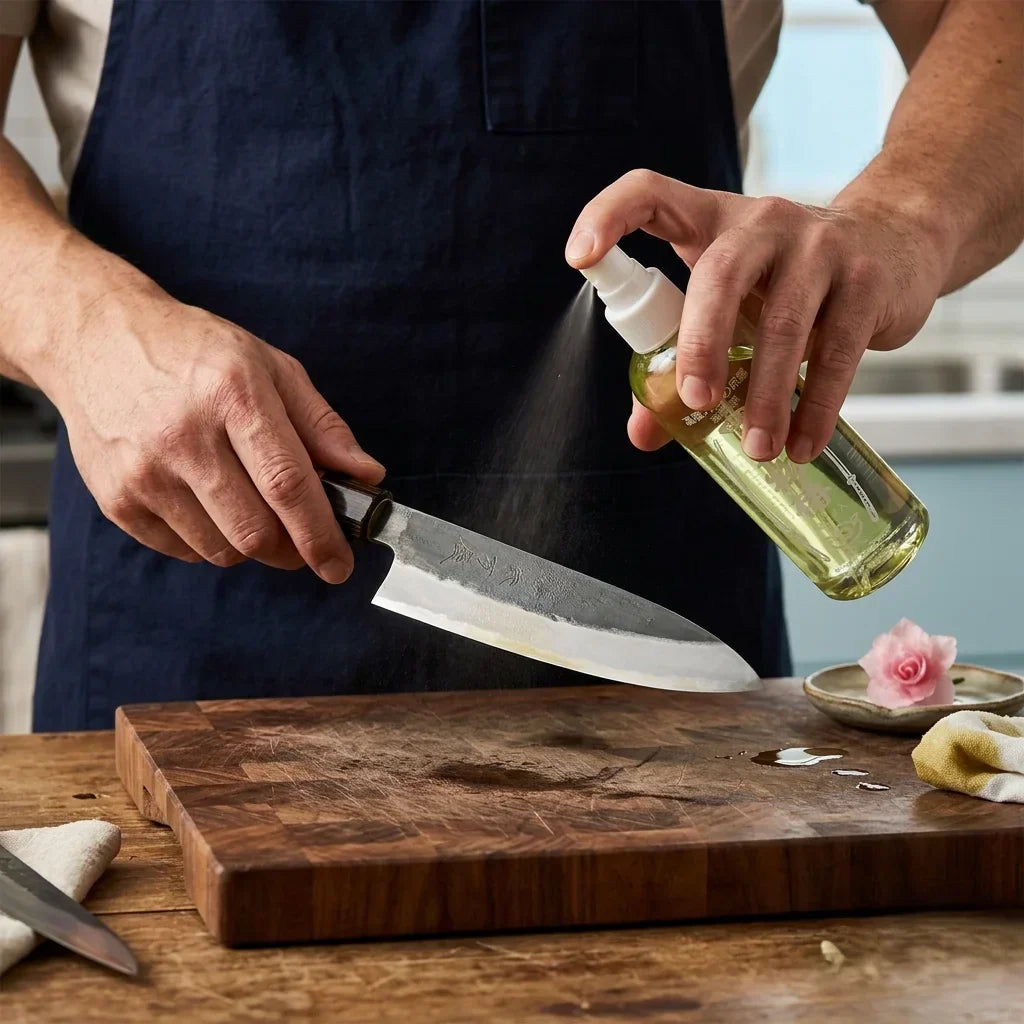
Applying camellia oil to a high-carbon blade after use
Applying camellia oil to a high-carbon blade after use
Caring for a High-Carbon Knife
A high-carbon knife asks for a small amount of attention in return for exceptional performance. The routine is simple once it becomes habit — and most experienced cooks find it a satisfying part of owning a serious knife.
The single most important step is drying the blade immediately after use or rinsing. A dry carbon steel blade will not rust. It is only moisture left on the surface — even for a few minutes — that causes problems.
Over time, regular use builds a natural patina. Far from being damage, this dark layer is a sign of a well-used, well-loved knife. It acts as a mild barrier against further oxidation and makes the blade your own.
Complete Care Routine
-
1
Rinse & Dry ImmediatelyAfter every use, rinse the blade under warm water and dry it thoroughly with a soft cloth before setting it down. Never leave it sitting in water or in a drying rack wet. This single step prevents the vast majority of rust issues.
-
2
Apply Camellia Oil for StorageIf storing the knife for more than a day or two, wipe the blade lightly with food-safe camellia oil (椿油) using a soft cloth. A thin, even coat is sufficient. Camellia oil is the traditional choice in Japanese knife care — it penetrates evenly and does not go rancid. Neutral cooking oil works as a substitute for short-term storage.
-
3
Embrace the PatinaA dark grey or brown patina is not damage — it is the steel stabilising naturally. Some cooks accelerate patina formation by rubbing a cut lemon or onion on the blade. Once a solid patina develops, the blade becomes less reactive and easier to maintain day-to-day.
-
4
Sharpen Regularly on a WhetstoneHigh-carbon steel rewards whetstone sharpening. Start with a 1000-grit stone to restore the edge, then finish on a 3000–6000 grit stone for a refined, razor-sharp result. Sharpen in consistent strokes at the blade's original bevel angle — typically 12–15° for Japanese knives.
-
5
Remove Surface Rust PromptlyIf rust spots appear, remove them quickly with a rust eraser, fine cork, or baking soda paste before they deepen. Surface rust on carbon steel is normal and easily dealt with — it only becomes a problem if left untreated for extended periods.
-
6
Always Hand-Wash OnlyNever put a high-carbon knife in the dishwasher. The heat, moisture, and detergent will cause aggressive rusting on the blade, damage the handle, and dull the edge rapidly. A quick rinse and hand dry takes seconds and preserves the knife for decades.
Frequently Asked Questions
-
Will a high-carbon knife rust easily?
High-carbon steel is reactive, but it will not rust with basic care. The key rule is simple: never leave it wet. Dry the blade immediately after rinsing and apply a light coat of camellia oil for longer storage. Many people find that once they are in the habit, maintaining a carbon knife takes no longer than 30 seconds after each use. -
Is a high-carbon knife better than stainless?
Neither is objectively better — they suit different needs. High-carbon knives achieve a finer, keener edge and sharpen more easily, making them the preferred choice for professional chefs and serious home cooks who enjoy knife maintenance. Stainless knives offer better rust resistance and lower maintenance, making them more practical for everyday use in busy kitchens where care is less consistent. -
What is the dark discolouration on my carbon knife?
That is a patina — a natural iron-oxide layer that forms on carbon steel through contact with food, moisture, and air. It is not damage. A well-developed patina actually protects the blade from further oxidation and reduces the chance of surface rust during cooking. It also indicates the knife is being used and cared for properly. Some cooks deliberately cultivate a patina before the first use. -
What carbon content do Hinoura knives use?
Hinoura knives are hand-forged in Sanjo, Japan and use premium high-carbon steels including Aogami (Blue Paper Steel) Super and White Steel variants. These steels typically carry 1.0–1.5% carbon content, hardened to 62–65 HRC — placing them among the finest performance steels available in a kitchen knife. Each blade is individually forged and heat-treated by the Hinoura family in their Sanjo workshop. -
Can I use a carbon knife for acidic foods like citrus and tomatoes?
Yes, but rinse and dry the blade promptly afterwards. Acids accelerate patina formation and can cause surface discolouration more quickly than neutral foods. This is cosmetic rather than damaging — the blade will develop its patina faster in those areas. Some chefs avoid prolonged contact with highly acidic ingredients on an unpatinated blade, but a well-established patina handles most kitchen tasks without issue. -
How often should I sharpen a high-carbon knife?
This depends on how heavily the knife is used, the cutting surface (wood boards are gentler than plastic or ceramic), and the cutting technique. A home cook using the knife a few times a week might sharpen every 2–3 months. A professional in daily use might touch up the edge weekly. The advantage of high-carbon steel is that it sharpens quickly — a brief session on a 1000-grit stone restores the edge efficiently, so frequent light sharpening is better than waiting until the blade is noticeably dull.
Is a High-Carbon Knife Right for You?
High-carbon knives are not the right choice for everyone — but for those willing to offer a small amount of ongoing care, they are among the most rewarding tools in the kitchen. The sharpness is noticeable from the first cut. The sharpening is easy. And the blade becomes more personal with every use.
"A carbon knife does not just perform well. It ages beautifully — and with you."
If you want a low-effort blade you can wash and leave, a stainless option like VG10 or SG2 will serve you well. But if you appreciate fine tools, enjoy a ritual, and want to understand what Japanese knife-making is truly about — carbon steel is where that journey begins.
Ginza Steel · Carbon Steel Collection
Explore Our High-Carbon Knives
Discover hand-forged Japanese knives built from premium high-carbon steels — crafted by master smiths in Japan and curated for cooks who take their tools seriously.

Written by Online Support