How to Care for a Wooden Cutting Board

A good cutting board is one of the hardest-working tools in your kitchen. Treated well, a solid wood board can last decades — even a lifetime. Neglected, it will warp, crack, and fall apart within months.
This guide covers everything you need to keep your board clean, conditioned, and safe for years to come — from daily washing habits to the Japanese tradition of camellia oil conditioning.
Before diving into care, it helps to understand that different boards need different levels of attention. The more natural the material, the more care it rewards.
Single-piece hardwood (maple, walnut, cherry, teak). Beautiful and durable, but highly sensitive to moisture. Requires regular oiling, waxing, and careful washing on all sides.
Glued timber pieces. More dimensionally stable than solid boards — less prone to warping — but still require regular oiling and correct washing habits.
HDPE or polyethylene boards. Dishwasher safe, non-porous, and moisture-resistant. Minimal conditioning needed — replace when deeply scored.
Important: A solid wood board cut from a single plank absorbs and releases moisture in one direction only — making it far more susceptible to warping if not cared for equally on all six surfaces, including the underside.
This is the single most important rule. Dishwashers expose wood to prolonged hot water, steam, and high-heat drying cycles. This causes wood fibres to expand and contract rapidly, leading to warping, cracking, and splitting. The alkaline detergents strip away any protective oil finish completely.
Never: Put any wooden or bamboo board in the dishwasher — without exception. Glued joints on end-grain and edge-grain boards will eventually fail entirely from repeated machine washing.
Always wash with cool or lukewarm water — never hot. Rinse quickly and dry immediately.
Always wash wooden boards with cool or lukewarm water. Hot water causes wood fibres to swell and open the grain, increasing moisture absorption and accelerating warping. A small amount of mild dish soap is perfectly safe if rinsed off promptly.
Never soak your board. Even a few minutes of soaking can cause lasting damage. Wash, rinse immediately, and dry.
After washing, pat both sides dry immediately with a clean cloth. Then stand the board upright on its side to allow air to circulate freely on both faces. Never lay a wet board flat on a countertop — this causes uneven drying, the leading cause of warping.
Tip: Solid wood boards are especially vulnerable to differential drying. If one face dries faster than the other, the board will cup toward the wetter side. Always expose both faces to air equally.
Oiling is the most important ongoing maintenance step. Oil prevents the wood from drying out, keeps it from absorbing water too readily, and stops cracking and splitting. It also maintains a hygienic surface by reducing the board's porosity.
- Food-grade mineral oil (best choice)
- Food-grade camellia oil (stable, odourless)
- Pure tung oil (fully cured)
- Board cream / wood butter
- Fractionated coconut oil
- Walnut oil (if no nut allergies)
- Olive oil — goes rancid
- Vegetable oil — goes rancid
- Sunflower oil — goes rancid
- Canola oil — goes rancid
- Any unstable cooking oil
Why cooking oils are dangerous: Oils that are not shelf-stable will turn rancid inside the wood, causing unpleasant odours and potentially contaminating food. Always use food-grade mineral oil or a purpose-made board oil.
Make sure the board is completely clean and dry before oiling. Any residual moisture will be sealed in by the oil.
Warm the oil very slightly — place the bottle in warm water for a few minutes. Warm oil penetrates the wood more deeply.
Apply a generous amount to all surfaces — both faces, all four edges, and the underside. Use a soft cloth or paper towel to work the oil into the grain.
Leave to absorb for a minimum of 4–6 hours, or ideally overnight.
Wipe off any excess oil that has not been absorbed. Repeat 2–3 times for best results, especially on a new board.

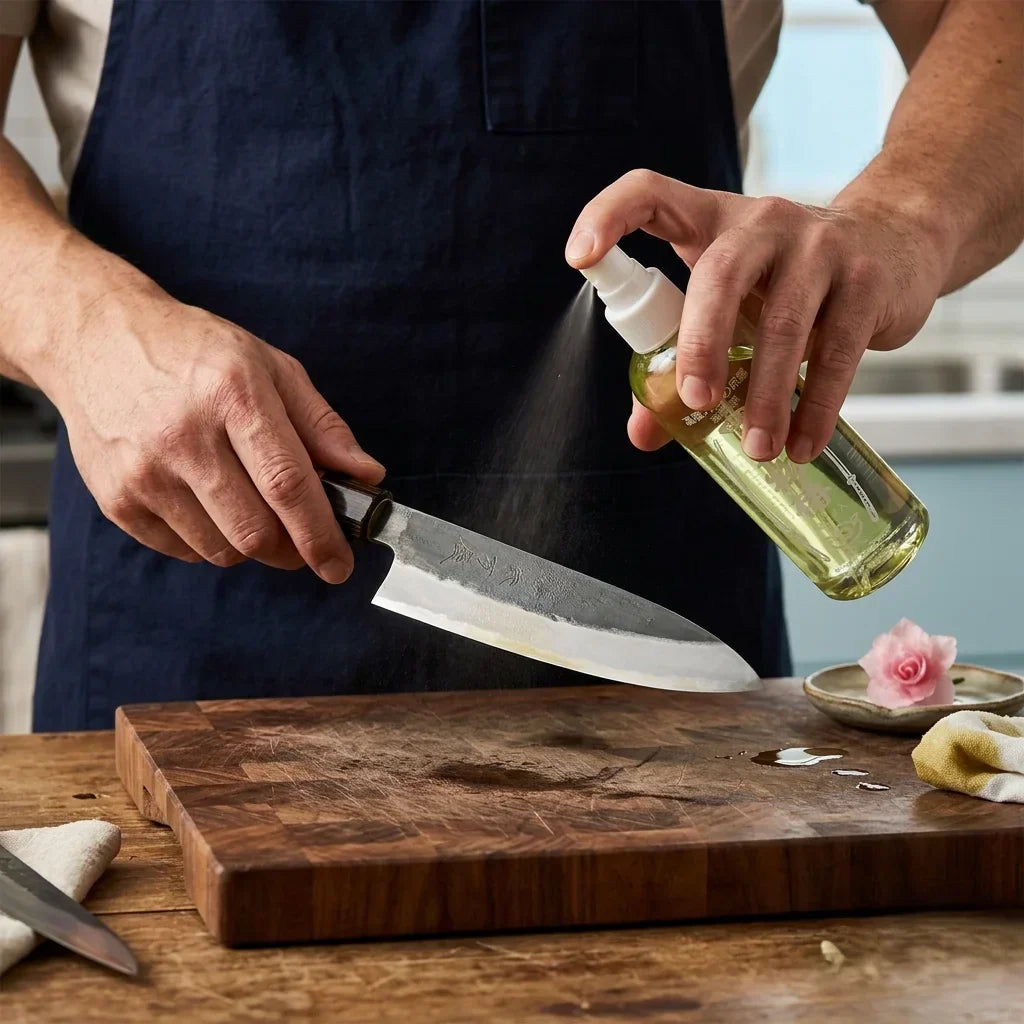
Food-grade camellia oil trusted in Japanese kitchens for centuries. Highly stable, virtually odourless, and completely safe for food-contact surfaces. Ideal for both wooden cutting boards and carbon steel blades.
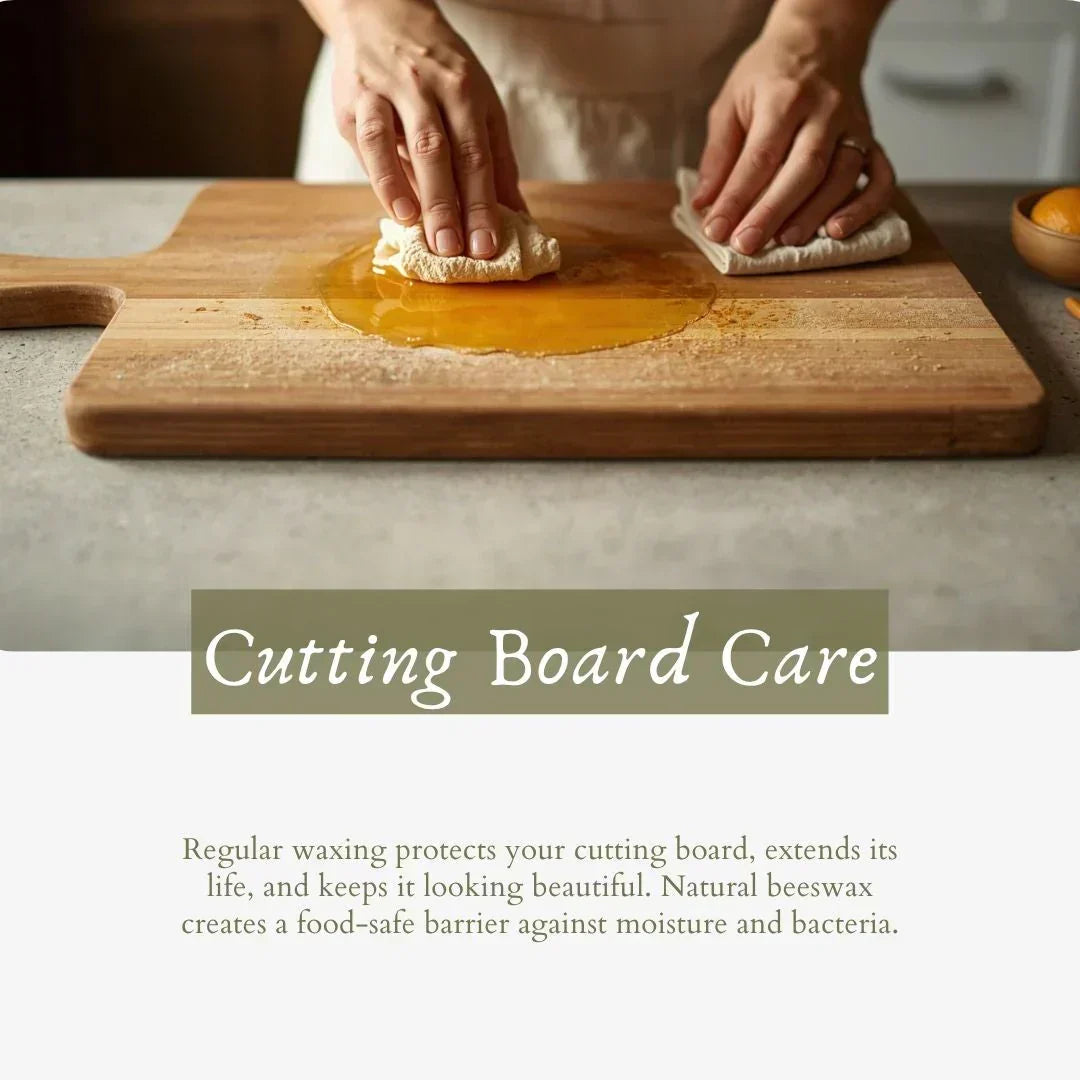
After oiling, applying a food-safe wax or board cream adds a second layer of protection that seals in the oil, repels water, and gives the board a beautiful low-sheen finish. This step is especially important for solid wood boards exposed to daily use.
Always oil the board first and allow it to fully absorb before applying wax.
Apply a small amount of board cream or beeswax using a soft cloth or your fingertips.
Work the wax into the surface using small circular motions, covering all faces and edges.
Leave to sit for 20–30 minutes to allow the wax to harden slightly.
Buff to a smooth finish with a clean dry cloth.
Cool water, mild soap, dry immediately on both sides.
Saturate all six surfaces thoroughly before putting the board to work.
Or whenever the board looks pale, feels dry, or water no longer beads on the surface.
Apply board cream or beeswax after oiling for a sealed, water-repelling finish.
The water bead test: Sprinkle a few drops of water onto your board. If the water beads up, the board is well-oiled. If it absorbs immediately into the wood, it's time to oil again.
Camellia oil for conditioning. Combekk boards built to last a lifetime.