Why Japanese Kitchen Knives Are Worth Every Penny
銀座鋼 • 職人技

Knife Guide · 包丁の知識
Why Japanese Kitchen Knives
Are Worth Every Penny —
And Often Cost Less Than You Think
Are Worth Every Penny —
And Often Cost Less Than You Think
The real story behind Japanese knife pricing: centuries of craft, superior steel, and a lifetime of performance explained.

一 Section I
Centuries of Craft Behind Every Blade
Japanese bladesmithing traces its roots to samurai sword-making — a tradition refined over more than a thousand years. The same principles of metallurgy, edge geometry, and heat treatment that defined the katana are applied, in miniature, to every kitchen knife that leaves a Japanese forge today.
At Ginza Steel, these techniques are not marketing language. Artisans follow hand-finishing processes passed down across generations, spending far more time on each knife than any automated production line allows. The result is a blade that feels balanced, responsive, and alive in the hand.
"A Japanese knife is not manufactured.
It is made — by someone who has spent years learning how a blade should behave."
It is made — by someone who has spent years learning how a blade should behave."
The art of shokunin · 職人
二 Section II
The Steel Makes All the Difference
Most budget kitchen knives use soft stainless steel that is easy to stamp and cheap to sharpen — but dulls quickly and holds an edge poorly. Japanese knives take a fundamentally different approach.
| Property | Mass-Produced Blade | Ginza Steel Japanese Knife |
|---|---|---|
| Steel hardness | 52–55 HRC | 58–65 HRC |
| Edge angle | 25–30° per side | 10–15° per side |
| Edge retention | Weeks | Months to years |
| Blade thickness | 3–4 mm, wedge grind | 1.5–2.5 mm, convex grind |
| Finishing | Machine ground | Hand-honed, mirror polish |
Higher hardness means the blade can be ground to a much finer angle without the edge rolling over. That thinner, sharper geometry is what makes Japanese knives feel like they glide — effortless through herbs, fish, and vegetables alike.

Seiryū 青龍 Series — four profiles, one standard.
Petty knife in motion — precision at every scale.
三 Section III
The Four Pillars of Hand-Forged Mastery
Every Ginza Steel knife undergoes a controlled forging and heat-treatment process where temperature, timing, and quench rate are tuned to the specific steel alloy. This is how the same material yields a blade that is both extremely hard and surprisingly resistant to chipping.
鍛
Forge-hardened core
Controlled heat treatment aligns the steel grain for optimal toughness and edge stability across years of use.
均
Hand-balanced geometry
Each blank is shaped and ground by hand so weight distribution suits the knife type — not a factory template.
刃
Artisan-finished edge
Final sharpening on waterstones creates a convex micro-bevel that cuts cleaner and dulls slower than machine edges.
柄
Premium handle materials
Hardwood, pakkawood, or resin handles are selected for grip, moisture resistance, and long-term stability.
四 Section IV
The True Cost of a Cheap Knife
A $25 stamped knife that needs replacing every two years costs $125 over a decade. A $120 Ginza Steel knife, properly maintained, lasts indefinitely — and performs better every single day in between. The math is straightforward.
Beyond money, there is the hidden cost of a poor cutting tool: more effort, more fatigue, less precision, and a higher risk of the blade skipping sideways. A sharp, well-balanced knife is genuinely safer. Professional chefs understand this intuitively.

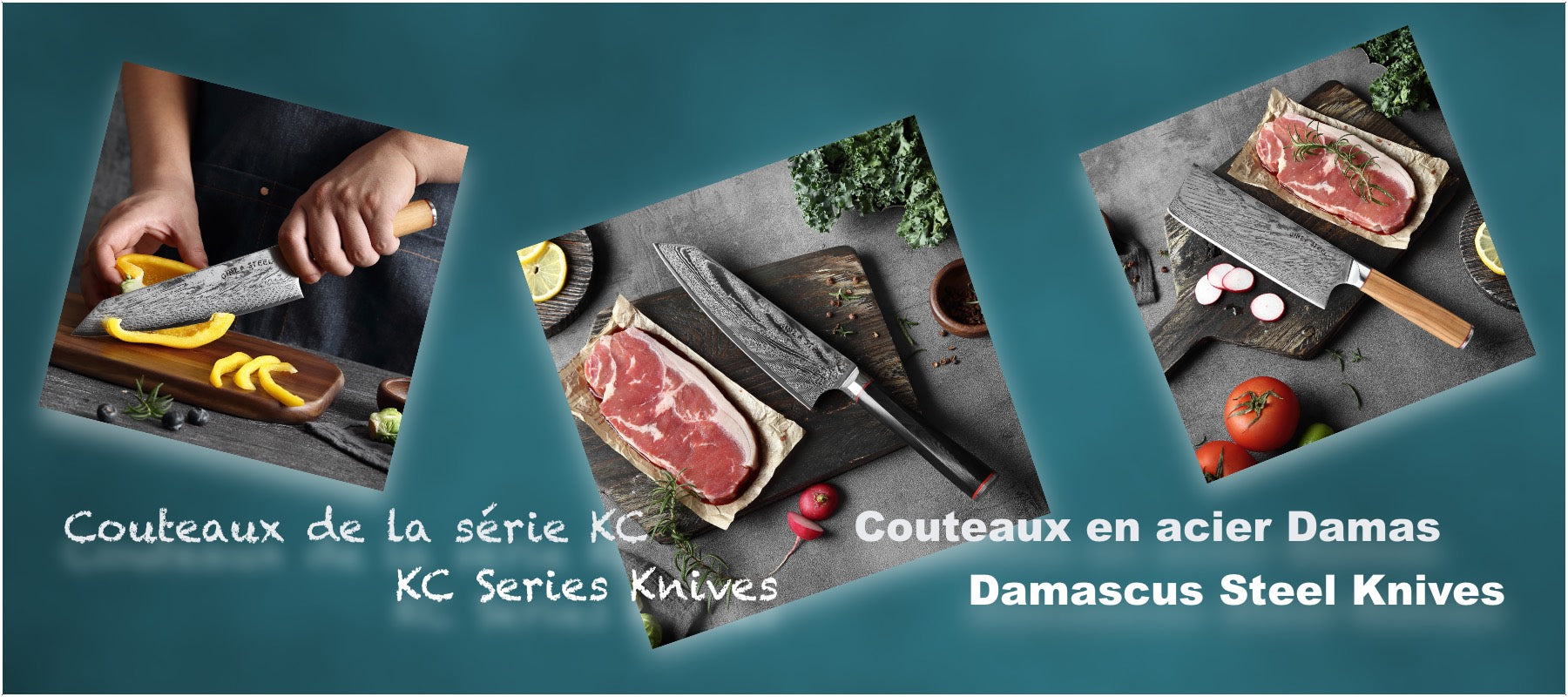
KC Series — every blade profile for every kitchen task.
五 Section V
Choosing the Right Japanese Knife
Japanese knives are purpose-designed, and selecting the right profile makes a genuine difference. Here is a concise guide to the most common types:
| Knife Type | Japanese | Best For | Length |
|---|---|---|---|
| Gyuto | 牛刀 | All-purpose: meat, fish, vegetables | 180–240 mm |
| Santoku | 三徳 | Home cooking, slicing & dicing | 165–180 mm |
| Petty | ペティ | Precision trimming, paring | 120–150 mm |
| Nakiri | 菜切り | Vegetables, push-cut technique | 165–180 mm |
| Sujihiki | 筋引き | Slicing proteins, sashimi prep | 240–300 mm |
| Kiritsuke | 切付け | Multi-purpose, advanced users | 210–240 mm |
六 Section VI
Caring for Your Investment
A Japanese knife maintained correctly will outlive almost everything else in your kitchen. Each accessory below is a deliberate choice — not an upsell:

守る Protect
Knife Guards
Blade sheaths that protect your edge — and your fingers — in drawers or travel bags.
Shop Guards →

切る Cut Right
Cutting Boards
Edge-kind wood surfaces — glass and hard plastic destroy a fine Japanese edge within weeks.
Shop Boards →

整える Maintain
Knife Care
Blade oils and care kits that prevent corrosion and keep high-carbon steel in peak condition.
Shop Care →

研ぐ Sharpen
Knife Sharpeners
Whetstones matched to Japanese blade geometry — no pull-through damage, no metal loss.
Shop Sharpeners →

収める Store
Knife Blocks
Magnetic ash wood blocks — blades stay dry, safe, and beautifully displayed on your counter.
Shop Blocks →
Ready to experience
the difference?
the difference?
Browse the full Ginza Steel collection — handcrafted Japanese kitchen knives, delivered directly to your door.
Shop All Knives →