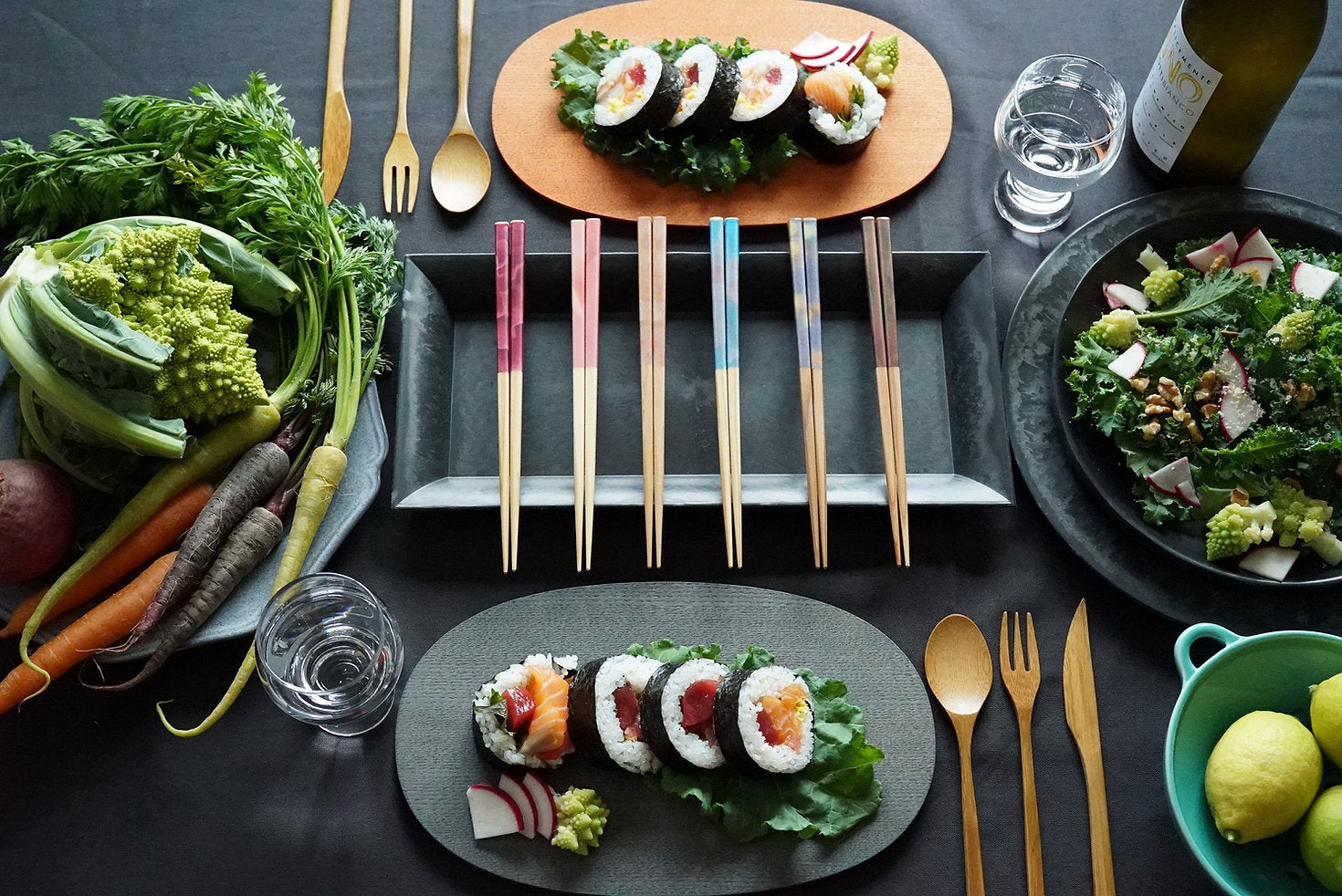
Baguettes japonaises : types, tailles et l'art des hashi
銀座スチール · Guide Ginza Steel
Baguettes Japonaises :
Types, Tailles et l'Art du Hashi
Types, Tailles et l'Art du Hashi
箸 · HASHI — L'Âme de la Table Japonaise
Du cèdre laqué traditionnel au bambou durable et réutilisable — tout ce qu'il faut savoir avant de choisir votre prochaine paire de baguettes japonaises.

Ginza Steel · Collection de Baguettes Japonaises Durables
一 · ICHI
Que Sont les Hashi ? Le Poids Culturel des Baguettes
En japonais, les baguettes sont appelées hashi (箸) — et elles portent une signification culturelle bien plus grande que leur forme simple ne le laisse paraître. Utilisées depuis plus de 1 000 ans, les hashi sont l'ustensile principal de presque chaque repas japonais, d'un simple bol de soupe miso à un dîner kaiseki élaboré.
Contrairement aux baguettes chinoises ou coréennes, les hashi japonaises sont généralement plus courtes, effilées vers une pointe plus fine, et conçues avec précision — reflétant la même philosophie qui façonne la coutellerie japonaise : la forme sert la fonction, et la fonction est indissociable de la beauté.
Choisir la bonne paire de baguettes n'est pas une décision anodine. Le matériau, la longueur, l'effilement et le poids influencent tous la façon dont les aliments sont saisis, séparés et appréciés. La collection de baguettes Ginza Steel repose sur cette compréhension.
Contrairement aux baguettes chinoises ou coréennes, les hashi japonaises sont généralement plus courtes, effilées vers une pointe plus fine, et conçues avec précision — reflétant la même philosophie qui façonne la coutellerie japonaise : la forme sert la fonction, et la fonction est indissociable de la beauté.
Choisir la bonne paire de baguettes n'est pas une décision anodine. Le matériau, la longueur, l'effilement et le poids influencent tous la façon dont les aliments sont saisis, séparés et appréciés. La collection de baguettes Ginza Steel repose sur cette compréhension.
Types de Baguettes Japonaises
箸の種類 · Un Guide des Styles de Hashi
菜箸
Sai-bashi
Cuisine · 30–40 cm
Le cheval de bataille culinaire de la cuisine japonaise. Avec 30 à 40 cm, ces longues baguettes de cuisine tiennent les mains à l'écart de la chaleur lors du remuage, du retournement et du dressage des plats chauds. Un incontournable des cuisines professionnelles.
料箸
Ryō-bashi
Quotidien · 24–27 cm
Baguettes de longueur moyenne, 24 à 27 cm — le choix incontournable pour la cuisine familiale de tous les jours. Elles équilibrent polyvalence et facilité de manipulation, ce qui en fait le choix pratique le plus polyvalent pour la cuisine à la maison.
皆箸
Kai-bashi
Service · 18–21 cm
Baguettes plus courtes, 18 à 21 cm, utilisées pour servir et dresser de petits plats. Leur longueur compacte ajoute élégance et précision aux présentations culinaires — une touche raffinée à table.
石井箸
Ishii-bashi
Spécialisé · 60 cm+
Baguettes extra-longues dépassant 60 cm, réservées à la préparation précise des sucreries japonaises et des plats délicats. Un outil d'un savoir-faire spécialisé — elles incarnent les exigences rigoureuses de la tradition culinaire japonaise.
渡し箸
Watashi-bashi
Communautaire · Service
Longues baguettes de service utilisées pour les repas communautaires — passer et servir des plats partagés à table. De longueur similaire aux sai-bashi, elles sont un choix pratique et hygiénique pour les repas familiaux et le service en restaurant.
盛り箸
Mori-bashi
Dressage · Précision
Baguettes fines à pointe précise utilisées par les chefs pour le dressage et la garniture méticuleux des plats. Les pointes extrêmement fines permettent le placement précis d'ingrédients délicats — un outil essentiel dans la cuisine kaiseki et la gastronomie japonaise raffinée.

持続可能性 · Durabilité
Pourquoi les Baguettes Durables Comptent
Le Japon utilise environ 25 milliards de baguettes jetables par an — un coût environnemental stupéfiant. Passer à une paire de hashi réutilisables de qualité est l'un des changements les plus simples et les plus significatifs qu'un foyer puisse adopter.
La gamme de baguettes durables de Ginza Steel est conçue avec cette responsabilité à l'esprit. Les matériaux sont sélectionnés pour leur longévité, leur renouvelabilité et le type de satisfaction tactile qui donne envie de les utiliser chaque jour — car une baguette qui n'est jamais remplacée est la baguette la plus écologique de toutes.
La gamme de baguettes durables de Ginza Steel est conçue avec cette responsabilité à l'esprit. Les matériaux sont sélectionnés pour leur longévité, leur renouvelabilité et le type de satisfaction tactile qui donne envie de les utiliser chaque jour — car une baguette qui n'est jamais remplacée est la baguette la plus écologique de toutes.
二 · NI
Guide des Tailles de Baguettes — Trouver Votre Longueur Idéale
La longueur de baguette adéquate n'est pas universelle. Au Japon, la règle traditionnelle veut que la longueur idéale d'une baguette équivaut à 1,5 fois la distance entre le bout du pouce et le bout de l'index lorsqu'ils forment un angle droit — environ un « empan ». En pratique, la plupart des baguettes pour adultes mesurent entre 22 et 25 cm, mais la longueur idéale dépend de la taille de la main, de l'usage et des préférences personnelles.
| Longueur | Idéal Pour | Remarques |
|---|---|---|
| 18–21 cm | Enfants (3 à 10 ans) | Plus courtes pour les petites mains ; meilleur contrôle de la prise en main pendant l'apprentissage |
| 21–23 cm | Femmes / Mains plus petites | Longueur standard pour femmes au Japon ; précise et légère |
| 23–25 cm | Hommes / Usage général adulte | Longueur la plus polyvalente ; convient à la plus large gamme de tailles de mains |
| 25–28 cm | Grandes mains / Utilisateurs occidentaux | Portée supplémentaire ; confortable pour les débutants aux baguettes |
| 30–45 cm | Cuisine (Saibashi) | Protection contre la chaleur ; utilisées pour remuer, frire et dresser les plats chauds |
三 · SAN
Comment Choisir les Bonnes Baguettes
Au-delà de la longueur, plusieurs facteurs déterminent si une paire de baguettes se sentira naturelle dans votre main :
Forme de la pointe : Les pointes fines (caractéristiques des hashi japonaises) permettent de saisir avec précision le poisson, les arêtes et les ingrédients délicats. Les pointes plus émoussées conviennent mieux au riz collant ou aux nouilles.
Poids du matériau : Le bambou et le cèdre légers semblent presque sans effort au fil d'un long repas. Les baguettes en bois dur et laquées offrent un poids agréable que de nombreux utilisateurs expérimentés préfèrent.
Texture de surface : Une pointe légèrement texturée ou au fini mat améliore considérablement la prise sur les aliments glissants. La laque entièrement polie est élégante mais exige plus de technique.
Réutilisabilité : Pour un usage quotidien et durable, une paire réutilisable bien conçue surpasse toujours les alternatives jetables — au toucher, pour l'environnement et, avec le temps, en termes de coût.
Découvrez la gamme complète dans la collection de baguettes écologiques de Ginza Steel →
Forme de la pointe : Les pointes fines (caractéristiques des hashi japonaises) permettent de saisir avec précision le poisson, les arêtes et les ingrédients délicats. Les pointes plus émoussées conviennent mieux au riz collant ou aux nouilles.
Poids du matériau : Le bambou et le cèdre légers semblent presque sans effort au fil d'un long repas. Les baguettes en bois dur et laquées offrent un poids agréable que de nombreux utilisateurs expérimentés préfèrent.
Texture de surface : Une pointe légèrement texturée ou au fini mat améliore considérablement la prise sur les aliments glissants. La laque entièrement polie est élégante mais exige plus de technique.
Réutilisabilité : Pour un usage quotidien et durable, une paire réutilisable bien conçue surpasse toujours les alternatives jetables — au toucher, pour l'environnement et, avec le temps, en termes de coût.
Découvrez la gamme complète dans la collection de baguettes écologiques de Ginza Steel →
箸置き · Hashioki
Le Repose-Baguettes — Petit Détail, Grande Signification
Dans l'étiquette de table japonaise, les baguettes ne sont jamais laissées posées en travers d'un bol ou plantées debout dans la nourriture — les deux portent des associations de mauvais augure. Le hashioki (箸置き), ou repose-baguettes, est la façon appropriée de poser les hashi entre les bouchées et à la fin d'un repas.
Un beau support en bois fait autant partie de la table que les baguettes elles-mêmes — un signal discret de soin et d'intention dans la façon dont le repas est présenté.
Un beau support en bois fait autant partie de la table que les baguettes elles-mêmes — un signal discret de soin et d'intention dans la façon dont le repas est présenté.

四 · SHI
Entretenir Vos Baguettes Réutilisables
Des hashi de qualité récompensent un bon entretien par des années — parfois des décennies — d'utilisation. Quelques habitudes simples font toute la différence :
Lavez à la main avec un savon doux et de l'eau tiède. Évitez de les faire tremper ou de les laisser immergées — une exposition prolongée à l'eau peut déformer le bois et fissurer la laque. Les lave-vaisselle sont trop agressifs pour les baguettes en bois ou laquées.
Séchez immédiatement et rangez-les debout ou à plat, jamais dans un tiroir humide. Une bonne circulation d'air entre les utilisations prévient les moisissures et les odeurs.
Ré-huilez périodiquement (pour les baguettes en bois non traité) avec de l'huile minérale alimentaire ou de l'huile de camélia — le même principe d'entretien que pour les manches de couteaux japonais.
Inspectez les pointes régulièrement. Une pointe effilochée ou éclatée sur des baguettes en bois doit être légèrement poncée avant que le problème ne s'aggrave.
Lavez à la main avec un savon doux et de l'eau tiède. Évitez de les faire tremper ou de les laisser immergées — une exposition prolongée à l'eau peut déformer le bois et fissurer la laque. Les lave-vaisselle sont trop agressifs pour les baguettes en bois ou laquées.
Séchez immédiatement et rangez-les debout ou à plat, jamais dans un tiroir humide. Une bonne circulation d'air entre les utilisations prévient les moisissures et les odeurs.
Ré-huilez périodiquement (pour les baguettes en bois non traité) avec de l'huile minérale alimentaire ou de l'huile de camélia — le même principe d'entretien que pour les manches de couteaux japonais.
Inspectez les pointes régulièrement. Une pointe effilochée ou éclatée sur des baguettes en bois doit être légèrement poncée avant que le problème ne s'aggrave.
持続可能な箸
Achetez les Baguettes
Durables Ginza Steel
Durables Ginza Steel
Matériaux écologiques. Savoir-faire japonais. Conçues pour remplacer le jetable pour de bon — et assez belles pour être utilisées à chaque repas.
Acheter des Baguettes →