Pourquoi les couteaux de cuisine japonais valent chaque centime
銀座鋼 • 職人技

Guide des Couteaux · 包丁の知識
Pourquoi les couteaux de cuisine japonais
valent chaque centime —
et coûtent souvent moins cher que vous ne le pensez
valent chaque centime —
et coûtent souvent moins cher que vous ne le pensez
La véritable histoire derrière le prix des couteaux japonais : des siècles de savoir-faire, un acier supérieur et des performances durables expliqués.

一 Section I
Des siècles de savoir-faire derrière chaque lame
La fabrication de lames japonaises tire ses racines de la fabrication des épées de samouraï – une tradition affinée sur plus de mille ans. Les mêmes principes de métallurgie, de géométrie du tranchant et de traitement thermique qui ont défini le katana sont appliqués, en miniature, à chaque couteau de cuisine qui sort aujourd'hui d'une forge japonaise.
Chez Ginza Steel, ces techniques ne sont pas un argument marketing. Les artisans suivent des procédés de finition manuelle transmis de génération en génération, passant beaucoup plus de temps sur chaque couteau que ne le permettrait une chaîne de production automatisée. Le résultat est une lame équilibrée, réactive et vivante en main.
"Un couteau japonais n'est pas fabriqué.
Il est fait — par quelqu'un qui a passé des années à apprendre comment une lame doit se comporter."
Il est fait — par quelqu'un qui a passé des années à apprendre comment une lame doit se comporter."
L'art du shokunin · 職人
二 Section II
L'acier fait toute la différence
La plupart des couteaux de cuisine bon marché utilisent de l'acier inoxydable doux, facile à emboutir et à aiguiser — mais qui s'émousse rapidement et tient mal son tranchant. Les couteaux japonais adoptent une approche fondamentalement différente.
| Propriété | Lame produite en série | Couteau japonais Ginza Steel |
|---|---|---|
| Dureté de l'acier | 52–55 HRC | 58–65 HRC |
| Angle du tranchant | 25–30° par côté | 10–15° par côté |
| Rétention du tranchant | Semaines | Mois à années |
| Épaisseur de la lame | 3–4 mm, mouture en coin | 1.5–2.5 mm, mouture convexe |
| Finition | Meulé à la machine | Affûté à la main, poli miroir |
Une dureté plus élevée signifie que la lame peut être affûtée à un angle beaucoup plus fin sans que le tranchant ne roule. Cette géométrie plus fine et plus tranchante est ce qui donne l'impression aux couteaux japonais de glisser — sans effort à travers les herbes, le poisson et les légumes.

Série Seiryū 青龍 — quatre profils, un seul standard.
Couteau Petty en action — précision à toutes les échelles.
三 Section III
Les quatre piliers de la maîtrise forgée à la main
Chaque couteau Ginza Steel subit un processus contrôlé de forgeage et de traitement thermique où la température, le temps et la vitesse de trempe sont adaptés à l'alliage d'acier spécifique. C'est ainsi que le même matériau produit une lame à la fois extrêmement dure et étonnamment résistante aux éclats.
鍛
Noyau forgé et trempé
Le traitement thermique contrôlé aligne le grain de l'acier pour une ténacité et une stabilité du tranchant optimales pendant des années d'utilisation.
均
Géométrie équilibrée à la main
Chaque ébauche est façonnée et meulée à la main afin que la répartition du poids corresponde au type de couteau — et non à un gabarit d'usine.
刃
Tranchant fini à la main
L'affûtage final sur pierres à eau crée un micro-biseau convexe qui coupe plus net et s'émousse plus lentement que les tranchants de machine.
柄
Matériaux de manche haut de gamme
Les manches en bois dur, pakkawood ou résine sont sélectionnés pour leur prise en main, leur résistance à l'humidité et leur stabilité à long terme.
四 Section IV
Le vrai coût d'un couteau bon marché
Un couteau embouti à 25 $ qui doit être remplacé tous les deux ans coûte 125 $ sur une décennie. Un couteau Ginza Steel à 120 $, correctement entretenu, dure indéfiniment — et est plus performant chaque jour. Le calcul est simple.
Au-delà de l'argent, il y a le coût caché d'un mauvais outil de coupe : plus d'effort, plus de fatigue, moins de précision, et un risque plus élevé que la lame dérape. Un couteau aiguisé et bien équilibré est réellement plus sûr. Les chefs professionnels le comprennent intuitivement.

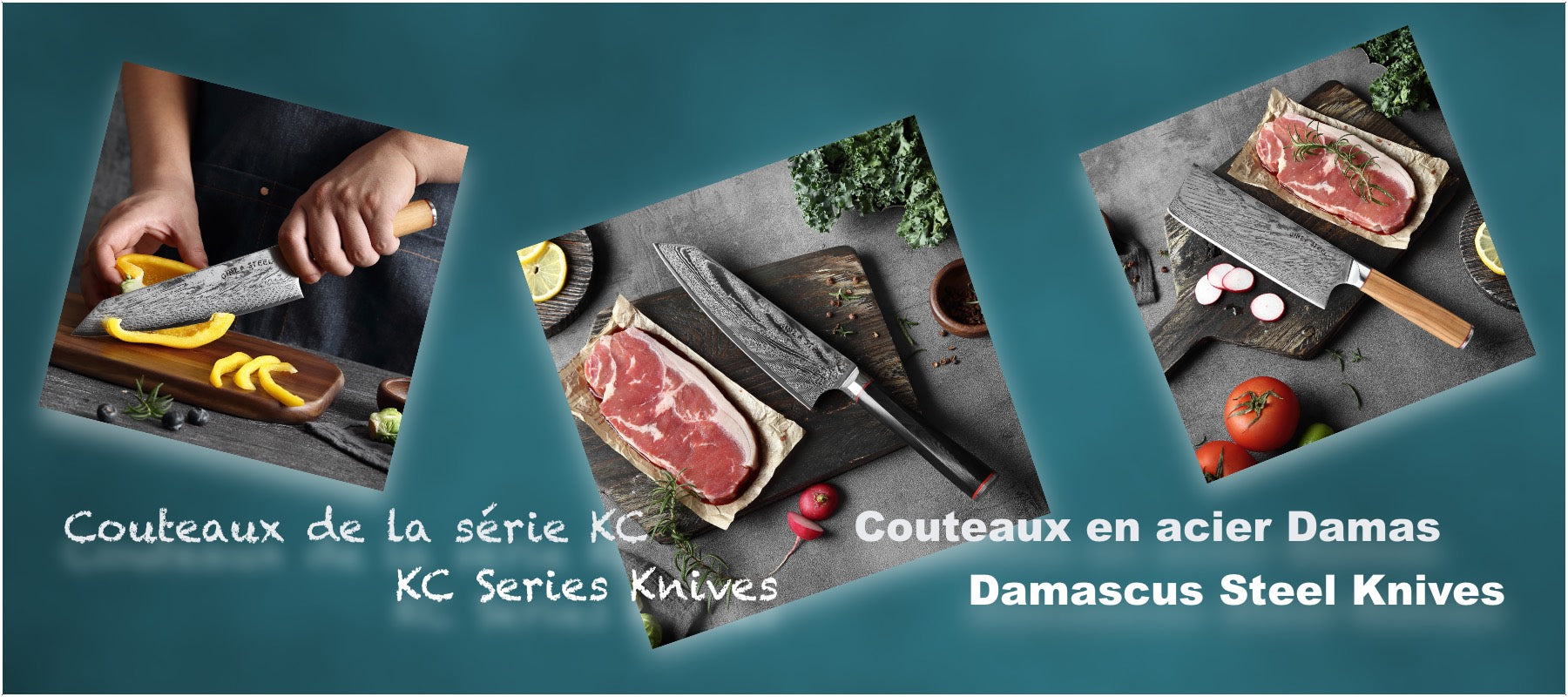
Série KC — chaque profil de lame pour chaque tâche culinaire.
五 Section V
Choisir le bon couteau japonais
Les couteaux japonais sont conçus à des fins spécifiques, et choisir le bon profil fait une réelle différence. Voici un guide concis des types les plus courants :
| Type de couteau | Japonais | Idéal pour | Longueur |
|---|---|---|---|
| Gyuto | 牛刀 | Polyvalent : viande, poisson, légumes | 180–240 mm |
| Santoku | 三徳 | Cuisine domestique, trancher & découper en dés | 165–180 mm |
| Petty | ペティ | Coupe de précision, parage | 120–150 mm |
| Nakiri | 菜切り | Légumes, technique de poussée | 165–180 mm |
| Sujihiki | 筋引き | Trancher les protéines, préparation de sashimis | 240–300 mm |
| Kiritsuke | 切付け | Polyvalent, utilisateurs avancés | 210–240 mm |
六 Section VI
Prendre soin de votre investissement
Un couteau japonais correctement entretenu survivra à presque tout le reste de votre cuisine. Chaque accessoire ci-dessous est un choix délibéré — et non une vente additionnelle :

守る Protéger
Protège-lames
Des fourreaux de lame qui protègent votre tranchant — et vos doigts — dans les tiroirs ou les sacs de voyage.
Acheter des protège-lames →

切る Couper juste
Planches à découper
Des surfaces en bois respectueuses du tranchant — le verre et le plastique dur détruisent un bon tranchant japonais en quelques semaines.
Acheter des planches →

整える Entretenir
Entretien des couteaux
Huiles pour lames et kits d'entretien qui préviennent la corrosion et maintiennent l'acier à haute teneur en carbone en parfait état.
Acheter des produits d'entretien →

研ぐ Affûter
Affûteurs de couteaux
Pierres à aiguiser adaptées à la géométrie des lames japonaises — pas de dommages par traction, pas de perte de métal.
Acheter des affûteurs →

収める Ranger
Blocs à couteaux
Blocs magnétiques en bois de frêne — les lames restent sèches, en sécurité et joliment exposées sur votre comptoir.
Acheter des blocs →
Prêt à faire l'expérience
de la différence ?
de la différence ?
Découvrez la collection complète Ginza Steel — des couteaux de cuisine japonais fabriqués à la main, livrés directement chez vous.
Découvrir tous les couteaux →