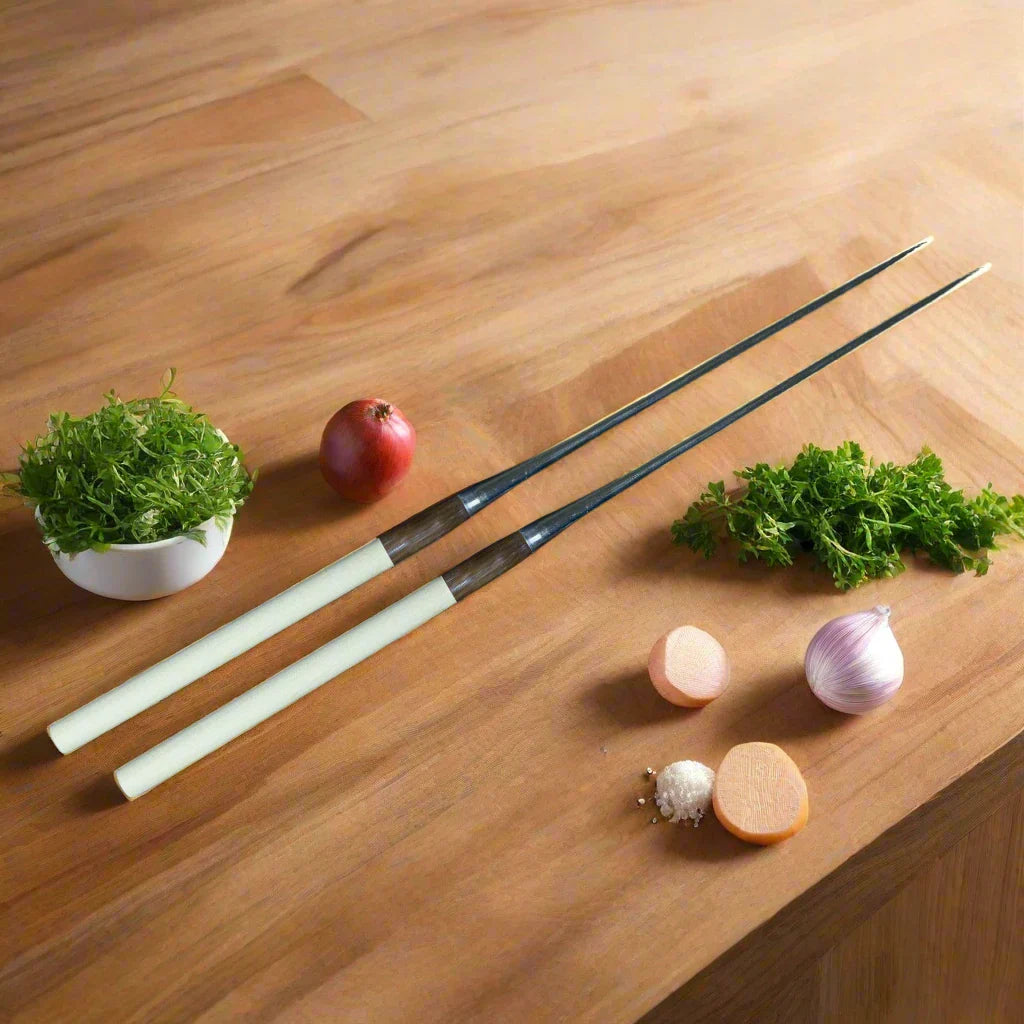
Découvrez les Moribashi — les baguettes de cuisine de précision japonaises utilisées par les chefs professionnels pour le dressage, la garniture et la manipulation des ingrédients délicats. Explorez notre collection haut de gamme sur JapanChefKnife.com

Dans la cuisine japonaise, où la précision et la présentation sont primordiales, les Moribashi (盛箸) jouent un rôle crucial. Ces baguettes de cuisine de qualité professionnelle sont utilisées par les maîtres sushi et les cuisiniers amateurs pour sublimer l'art du dressage, de la garniture et de la manipulation des ingrédients délicats avec un contrôle inégalé.
Contrairement aux baguettes ordinaires, les Moribashi sont dotées de pointes ultra-effilées qui permettent un placement exact des garnitures — des fleurs comestibles aux micropousses — reflétant la philosophie japonaise du katachi, l'harmonie de la forme et de la fonction.


Comprendre les différences vous aide à choisir le bon outil pour un dressage de niveau professionnel et une manipulation délicate des aliments.
| Caractéristique | Moribashi | Baguettes ordinaires |
|---|---|---|
| Forme de la pointe | Effilée ultra-fine pour la précision | Émoussée ou légèrement effilée |
| Longueur | Plus longue (généralement 30–33 cm) | Standard 23–26 cm |
| Matériau | Acier inoxydable, bambou ou bois | Bois, bambou, plastique |
| Utilisation principale | Dressage, garniture, arrangement fin des aliments | Manger, cuisine générale |
| Résistance à la chaleur | Élevée (modèles en acier inoxydable) | Limitée |
| Idéal pour | Chefs sushi, cuisiniers amateurs, artistes du dressage | Repas quotidiens |
| Niveau de contrôle | Qualité professionnelle | Usage général |
Les Moribashi sont plus qu'un simple ustensile de cuisine — c'est une expression de l'intention culinaire. Voici pourquoi les chefs du monde entier les utilisent :
-
1Précision chirurgicaleLes pointes effilées permettent un placement méticuleux même de la plus petite garniture — fleurs comestibles, micropousses, zeste d'agrumes.
-
2Applications polyvalentesIdéales pour les sushis, sashimis, bols de nouilles, bentos, plateaux de charcuterie, et tout plat où la présentation compte.
-
3Dressage amélioréObtenez le style de présentation raffiné qui définit l'omakase japonais — chaque élément placé avec intention.
-
4Conçues pour durerLes modèles en acier inoxydable résistent à une utilisation professionnelle quotidienne, à la corrosion et conservent leurs pointes aiguisées pendant des années.
Maîtriser les Moribashi demande de la pratique, mais la technique est simple. Le diagramme de prise en main ci-dessous vous guide à travers les six étapes :
Un entretien approprié permet à vos Moribashi de rester comme neuves pendant des années. Suivez ces directives simples :
| Matériau | Nettoyage | Rangement | À éviter |
|---|---|---|---|
| Acier inoxydable | Lavage à la main avec un savon doux, bien rincer | Sécher à l'air libre, à la verticale ou dans un rouleau | Lave-vaisselle (ternit les pointes) |
| Bois / Bambou | Essuyer, éviter de tremper | Sécher à plat, loin de la chaleur | Exposition prolongée à l'eau |
| Tous types | Sécher immédiatement après lavage | Étui ou rouleau à baguettes dédié | Laisser reposer dans l'eau ou sur une serviette humide |
Moribashi authentiques