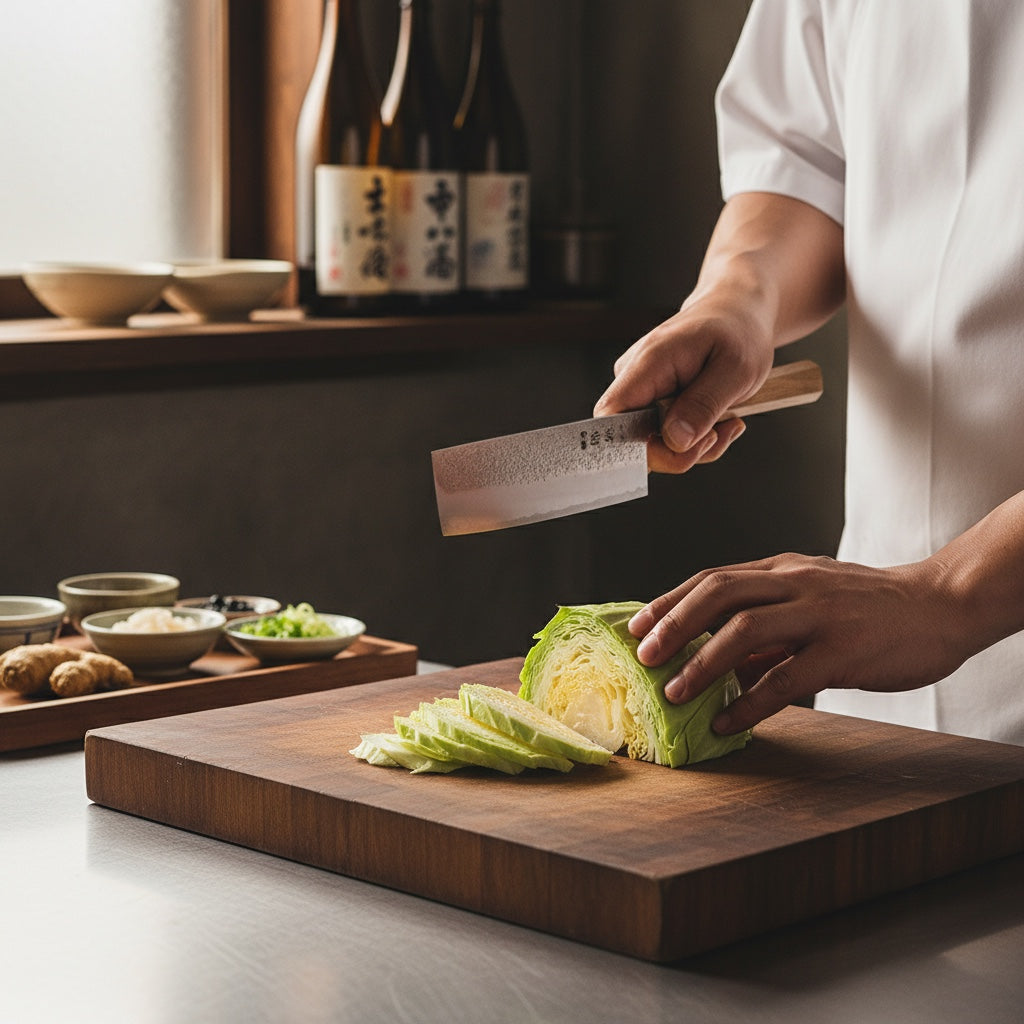
Couteaux à haute teneur en carbone : tout ce que vous devez savoir
炭素鋼
Ginza Steel · Série Connaissance des Couteaux
Couteaux à haute teneur en carbone
Tout ce que vous devez savoir
高炭素鋼 · Kōtanso-kō
Tout ce que vous devez savoir
Ce que signifie réellement la teneur en carbone, comment elle influence la performance de votre lame, et comment entretenir correctement un couteau à haute teneur en carbone.
Le Fondement de la Fabrication de Lames Japonaises
La teneur en carbone est l'un des facteurs les plus importants dans la performance d'un couteau de cuisine. Elle détermine la dureté, la rétention du tranchant, le comportement à l'affûtage et la manière dont la lame vieillit au fil du temps. La comprendre vous aide à choisir le bon couteau — et à en prendre soin correctement.
Que signifie "haute teneur en carbone" ?
La teneur en carbone fait référence au pourcentage de carbone présent dans un alliage d'acier. Pour les lames de couteaux, les aciers contenant plus de 0,6 % de carbone sont généralement classés comme des aciers à haute teneur en carbone. Les couteaux japonais haut de gamme utilisent souvent des aciers dont la teneur en carbone varie de 0,8 % à plus de 1,2 % — bien au-dessus de ce seuil.
Le carbone est ce qui confère à l'acier son potentiel de dureté. Plus la teneur en carbone est élevée, plus l'acier peut être durci par traitement thermique (trempe et revenu). Un acier plus dur conserve un tranchant plus aiguisé plus longtemps — mais il exige également plus de compétence pour l'affûter et plus de soin pour l'entretenir.
"Le carbone est l'élément qui transforme le fer en une lame digne d'être utilisée. Trop peu, et il ne peut pas tenir un tranchant. Juste assez, et il devient quelque chose de remarquable."
La plupart des couteaux de cuisine occidentaux utilisent des aciers avec 0,3 à 0,5 % de carbone. Les couteaux japonais traditionnels — en particulier ceux fabriqués à partir de Shirogami (acier blanc) ou d'Aogami (acier bleu) — contiennent généralement de 1,0 à 1,4 % de carbone. C'est une différence significative, et c'est pourquoi les couteaux japonais sont réputés pour leur tranchant extraordinaire.

Entretien de l'acier au carbone
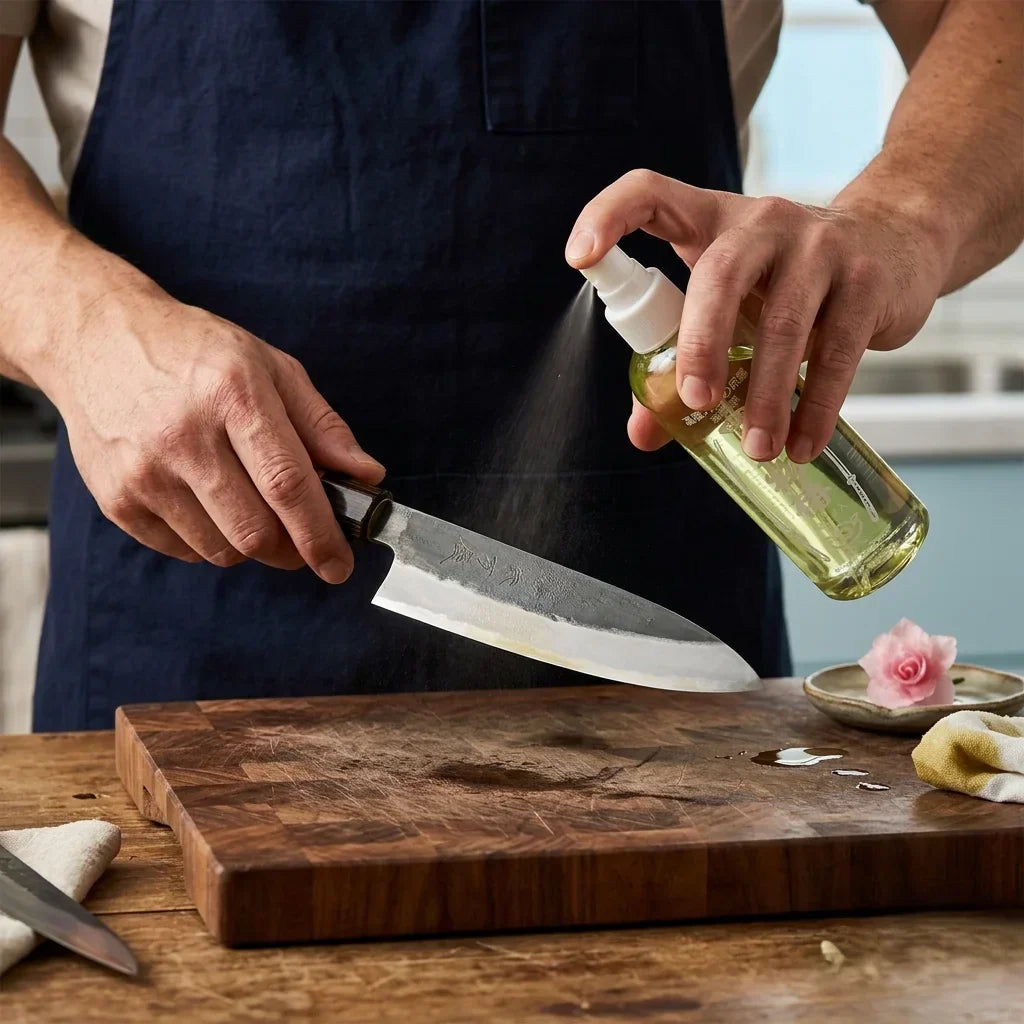
L'huile de camélia — le choix traditionnel pour protéger les lames de couteaux en acier à haute teneur en carbone
L'huile de camélia — le choix traditionnel pour protéger les lames de couteaux en acier à haute teneur en carbone
Comment la teneur en carbone affecte la performance
La relation entre la teneur en carbone et la performance du couteau est directe et significative. Voici ce qui change à mesure que le carbone augmente :
| Propriété | Haute teneur en carbone (1,0%+) | Inoxydable / SG2 | Faible teneur en carbone (<0,5%) |
|---|---|---|---|
| Dureté maximale (HRC) | 62–65+ | 60–64 | 52–56 |
| Potentiel de tranchant | Exceptionnel — tranchant le plus fin réalisable | Excellent | Modéré |
| Rétention du tranchant | Très bonne à exceptionnelle | Exceptionnel | Faible |
| Facilité d'affûtage | Répond rapidement aux pierres à aiguiser | Exige habileté et temps | Facile mais s'émousse vite |
| Résistance à la rouille | Réactif — nécessite des soins | Excellent inoxydable | Modéré |
| Développement de la patine | Oui — protection naturelle | Aucune | Légère |
| Meilleure utilisation | Cuisines professionnelles, passionnés | Usage professionnel quotidien | Décontracté, peu d'entretien |
Tranchant plus aiguisé
Une teneur en carbone plus élevée permet une structure de grain plus fine, permettant un angle de tranchant plus aigu et une sensation de coupe plus nette que les aciers à faible teneur en carbone.
Durée de vie du tranchant plus longue
L'acier plus dur s'use plus lentement, ce qui signifie moins de passages à la pierre à aiguiser entre les sessions. Une lame en carbone bien entretenue reste tranchante malgré une utilisation intensive.
Réactif à l'affûtage
Les aciers à haute teneur en carbone comme le White #2 réagissent rapidement aux pierres à aiguiser. Même une pierre de grain 1000 permet de retrouver un tranchant fonctionnel en quelques minutes.
Patine vivante
L'acier au carbone réactif développe une patine foncée à l'usage. Cette couche d'oxyde de fer protège en fait la lame et réduit sa réactivité continue.
Nécessite un contrôle de l'humidité
Sans chrome, l'acier à haute teneur en carbone rouillera s'il est laissé humide. Un séchage rapide après utilisation suffit à prévenir l'oxydation de surface.
Agréable à utiliser
De nombreux chefs trouvent les couteaux à haute teneur en carbone plus intuitifs — le retour d'information à travers la lame est plus net, et la coupe plus précise que leurs équivalents en acier inoxydable.

Soins appropriés
Application d'huile de camélia sur une lame à haute teneur en carbone après utilisation
Application d'huile de camélia sur une lame à haute teneur en carbone après utilisation
Entretenir un couteau à haute teneur en carbone
Un couteau à haute teneur en carbone demande un peu d'attention en échange de performances exceptionnelles. La routine est simple une fois qu'elle devient une habitude — et la plupart des cuisiniers expérimentés trouvent cela une partie satisfaisante de la possession d'un couteau sérieux.
L'étape la plus importante est de sécher la lame immédiatement après utilisation ou rinçage. Une lame en acier au carbone sèche ne rouillera pas. Seule l'humidité laissée sur la surface — même pendant quelques minutes — pose problème.
Au fil du temps, une utilisation régulière développe une patine naturelle. Loin d'être un dommage, cette couche sombre est le signe d'un couteau bien utilisé et bien-aimé. Elle agit comme une légère barrière contre une oxydation supplémentaire et rend la lame unique.
Routine d'entretien complète
-
1
Rincer et sécher immédiatementAprès chaque utilisation, rincez la lame sous l'eau tiède et séchez-la soigneusement avec un chiffon doux avant de la poser. Ne la laissez jamais tremper dans l'eau ou humide sur un égouttoir. Cette seule étape prévient la grande majorité des problèmes de rouille.
-
2
Appliquer de l'huile de camélia pour le stockageSi vous rangez le couteau pendant plus d'un ou deux jours, essuyez légèrement la lame avec de l'huile de camélia de qualité alimentaire (椿油) à l'aide d'un chiffon doux. Une couche fine et uniforme suffit. L'huile de camélia est le choix traditionnel pour l'entretien des couteaux japonais — elle pénètre uniformément et ne rancit pas. L'huile de cuisson neutre peut être utilisée comme substitut pour un stockage à court terme.
-
3
Adoptez la patineUne patine gris foncé ou brune n'est pas un dommage — c'est l'acier qui se stabilise naturellement. Certains cuisiniers accélèrent la formation de la patine en frottant un citron coupé ou un oignon sur la lame. Une fois qu'une patine solide se développe, la lame devient moins réactive et plus facile à entretenir au quotidien.
-
4
Affûter régulièrement sur une pierre à aiguiserL'acier à haute teneur en carbone récompense l'affûtage à la pierre. Commencez avec une pierre de grain 1000 pour restaurer le tranchant, puis terminez sur une pierre de grain 3000 à 6000 pour un résultat raffiné et extrêmement tranchant. Aiguisez par mouvements constants à l'angle de biseau original de la lame — généralement 12 à 15° pour les couteaux japonais.
-
5
Retirer rapidement la rouille de surfaceSi des taches de rouille apparaissent, retirez-les rapidement avec une gomme à rouille, un bouchon de liège fin ou une pâte de bicarbonate de soude avant qu'elles ne s'incrustent. La rouille de surface sur l'acier au carbone est normale et facilement traitable — elle ne devient un problème que si elle est laissée sans traitement pendant de longues périodes.
-
6
Toujours laver à la main uniquementNe mettez jamais un couteau à haute teneur en carbone au lave-vaisselle. La chaleur, l'humidité et le détergent provoqueront une rouille agressive sur la lame, endommageront le manche et émousseront rapidement le tranchant. Un rinçage rapide et un séchage à la main ne prennent que quelques secondes et préservent le couteau pendant des décennies.
Questions Fréquemment Posées
-
Un couteau à haute teneur en carbone rouillera-t-il facilement ?
L'acier à haute teneur en carbone est réactif, mais il ne rouillera pas avec des soins de base. La règle clé est simple : ne le laissez jamais humide. Séchez la lame immédiatement après le rinçage et appliquez une légère couche d'huile de camélia pour un stockage plus long. Beaucoup de gens constatent qu'une fois qu'ils ont pris l'habitude, l'entretien d'un couteau en carbone ne prend pas plus de 30 secondes après chaque utilisation. -
Un couteau à haute teneur en carbone est-il meilleur que l'acier inoxydable ?
Aucun n'est objectivement meilleur — ils répondent à des besoins différents. Les couteaux à haute teneur en carbone atteignent un tranchant plus fin et plus aiguisé et s'aiguisent plus facilement, ce qui en fait le choix préféré des chefs professionnels et des cuisiniers amateurs sérieux qui apprécient l'entretien des couteaux. Les couteaux en acier inoxydable offrent une meilleure résistance à la rouille et moins d'entretien, ce qui les rend plus pratiques pour un usage quotidien dans les cuisines très fréquentées où l'entretien est moins constant. -
Qu'est-ce que la décoloration foncée sur mon couteau en carbone ?
C'est une patine — une couche naturelle d'oxyde de fer qui se forme sur l'acier au carbone au contact des aliments, de l'humidité et de l'air. Ce n'est pas un dommage. Une patine bien développée protège en fait la lame d'une oxydation supplémentaire et réduit le risque de rouille de surface pendant la cuisson. Elle indique également que le couteau est utilisé et entretenu correctement. Certains cuisiniers cultivent délibérément une patine avant la première utilisation. -
Quelle teneur en carbone les couteaux Hinoura utilisent-ils ?
Les couteaux Hinoura sont forgés à la main à Sanjo, au Japon, et utilisent des aciers à haute teneur en carbone de première qualité, notamment les variantes Aogami (acier papier bleu) Super et Acier Blanc. Ces aciers contiennent généralement 1,0 à 1,5 % de carbone, durcis à 62–65 HRC — les plaçant parmi les meilleurs aciers de performance disponibles pour un couteau de cuisine. Chaque lame est forgée et traitée thermiquement individuellement par la famille Hinoura dans leur atelier de Sanjo. -
Puis-je utiliser un couteau en carbone pour des aliments acides comme les agrumes et les tomates ?
Oui, mais rincez et séchez la lame rapidement après. Les acides accélèrent la formation de la patine et peuvent provoquer une décoloration de surface plus rapidement que les aliments neutres. C'est cosmétique plutôt que dommageable — la lame développera sa patine plus rapidement dans ces zones. Certains chefs évitent un contact prolongé avec des ingrédients très acides sur une lame non patinée, mais une patine bien établie gère la plupart des tâches de cuisine sans problème. -
À quelle fréquence dois-je aiguiser un couteau à haute teneur en carbone ?
Cela dépend de l'intensité d'utilisation du couteau, de la surface de coupe (les planches en bois sont plus douces que le plastique ou la céramique) et de la technique de coupe. Un cuisinier amateur utilisant le couteau quelques fois par semaine pourrait l'aiguiser tous les 2 à 3 mois. Un professionnel en utilisation quotidienne pourrait retoucher le tranchant chaque semaine. L'avantage de l'acier à haute teneur en carbone est qu'il s'aiguise rapidement — une courte séance sur une pierre de grain 1000 restaure efficacement le tranchant, il est donc préférable d'aiguiser légèrement et fréquemment plutôt que d'attendre que la lame soit nettement émoussée.
Un couteau à haute teneur en carbone est-il fait pour vous ?
Les couteaux à haute teneur en carbone ne conviennent pas à tout le monde — mais pour ceux qui sont prêts à leur accorder un minimum d'attention, ils comptent parmi les outils les plus gratifiants de la cuisine. Le tranchant est perceptible dès la première coupe. L'aiguisage est facile. Et la lame devient plus personnelle à chaque utilisation.
"Un couteau en carbone ne se contente pas de bien performer. Il vieillit magnifiquement — et avec vous."
Si vous souhaitez une lame facile d'entretien que vous pouvez laver et laisser, une option en acier inoxydable comme le VG10 ou le SG2 vous conviendra parfaitement. Mais si vous appréciez les beaux outils, aimez les rituels et souhaitez comprendre ce qu'est véritablement la fabrication de couteaux japonais — l'acier au carbone est le point de départ de ce voyage.
Ginza Steel · Collection Acier au Carbone
Explorez nos Couteaux à Haute Teneur en Carbone
Découvrez des couteaux japonais forgés à la main à partir d'aciers de première qualité à haute teneur en carbone — fabriqués par des maîtres forgerons au Japon et sélectionnés pour les cuisiniers qui prennent leurs outils au sérieux.

Ecrit par Online Support