Le Couteau par GÜDE Solingen FORGÉ MAIN EN ALLEMAGNE DEPUIS 1910


La plupart des couteaux portent des noms qui décrivent leur forme ou leur fonction — un couteau de chef, un santoku, un couteau d'office. GÜDE Solingen en a créé un simplement appelé The Knife. Ce n'est pas tant une vantardise qu'une affirmation de confiance : voilà ce qu'un couteau de cuisine devrait être. Forgé à la main à partir d'une seule pièce d'acier chrome-molybdène-vanadium à Solingen, en Allemagne, fini avec un manche en bois d'olivier, et récompensé par quatre prix internationaux de design, The Knife a mérité ce nom au fil de plus d'un siècle d'artisanat ininterrompu.
La désignation de l'acier sur un couteau n'est pas un simple argument marketing — elle détermine tout, de la façon dont la lame s'affûte à sa capacité à conserver son tranchant. Le choix de GÜDE pour un acier inoxydable chrome-molybdène-vanadium (Cr-Mo-V) est délibéré et techniquement réfléchi. Chaque élément joue un rôle distinct.
Le chrome (Cr) assure la résistance à la corrosion, gardant la lame inoxydable même dans l'environnement humide et acide d'une cuisine active. Le molybdène (Mo) augmente la trempabilité et la ténacité — la lame peut être meulée finement sans devenir cassante. Le vanadium (V) affine la structure du grain lors de la trempe, ce qui se traduit directement par une meilleure tenue du tranchant : plus le grain est fin, plus la lame reste affûtée longtemps entre deux affûtages.
L'acier obtenu est trempé sur glace jusqu'à environ 57 HRC — assez dur pour conserver un tranchant de précision lors d'un usage quotidien intensif, mais assez résistant pour absorber les forces latérales qui fissurent les aciers plus cassants. C'est une spécification optimisée pour une cuisine professionnelle, pas pour une vitrine.
À 57 HRC, la lame se situe dans la zone idéale pour les couteaux forgés de style européen : assez dure pour une excellente tenue du tranchant, assez flexible pour résister à l'ébréchure face à un os ou un légume dur. Les aciers plus durs (60+ HRC, courants dans les couteaux japonais à biseau unique) exigent une technique plus soignée et sont plus sujets aux micro-éclats sous contrainte latérale. Le 57 HRC de GÜDE est la spécification d'un couteau conçu pour être utilisé intensivement, chaque jour, pendant des décennies.
Karl Güde fonde l'entreprise à Solingen en 1910. Solingen n'est pas simplement une ville de la Rhénanie allemande — c'est la ville des lames, un lieu où l'art de la coutellerie est pratiqué sans interruption depuis plus de 700 ans. La concentration du savoir-faire y est unique : forgerons, meuleurs, fabricants de manches et spécialistes de la trempe travaillent en étroite proximité depuis des générations, bâtissant une base de connaissances collectives impossible à reproduire ailleurs.
L'entreprise s'est transmise sur trois générations jusqu'à Franz Güde, dont les perfectionnements aux méthodes de forge familiales ont défini la série Alpha telle qu'on la connaît aujourd'hui. Sa philosophie était simple : ne faire aucun compromis entre les exigences des chefs professionnels et les standards du travail artisanal. Chaque couteau GÜDE produit aujourd'hui à Solingen est le prolongement direct de cet engagement.
Chaque couteau GÜDE commence comme une seule barre d'acier Cr-Mo-V — aucune soudure, aucune jointure, aucune pièce de talon séparée fixée après coup. La lame et son talon intégré sont forgés à partir d'une seule pièce continue d'acier, ce qui a une importance structurelle : le talon n'est pas un point faible mais un prolongement de la structure du grain de la lame. C'est ce talon forgé d'un seul tenant qui permet le système d'équilibre « double crop » de GÜDE, où le poids du talon contrebalance la lame, et le manche en bois d'olivier contrebalance le talon — répartissant la masse pour que le couteau semble neutre en main.
Après le forgeage, la lame subit une trempe sur glace : une trempe sous zéro qui affine la structure cristalline de l'acier pour une meilleure ténacité. Elle est ensuite meulée et affûtée à la main par des artisans à Solingen — non par une machine automatisée, mais par des personnes capables de sentir la géométrie évoluer au fil du travail. La géométrie du tranchant qui en résulte varie légèrement d'un couteau à l'autre, ce qui n'est pas un défaut mais la signature du savoir-faire humain.

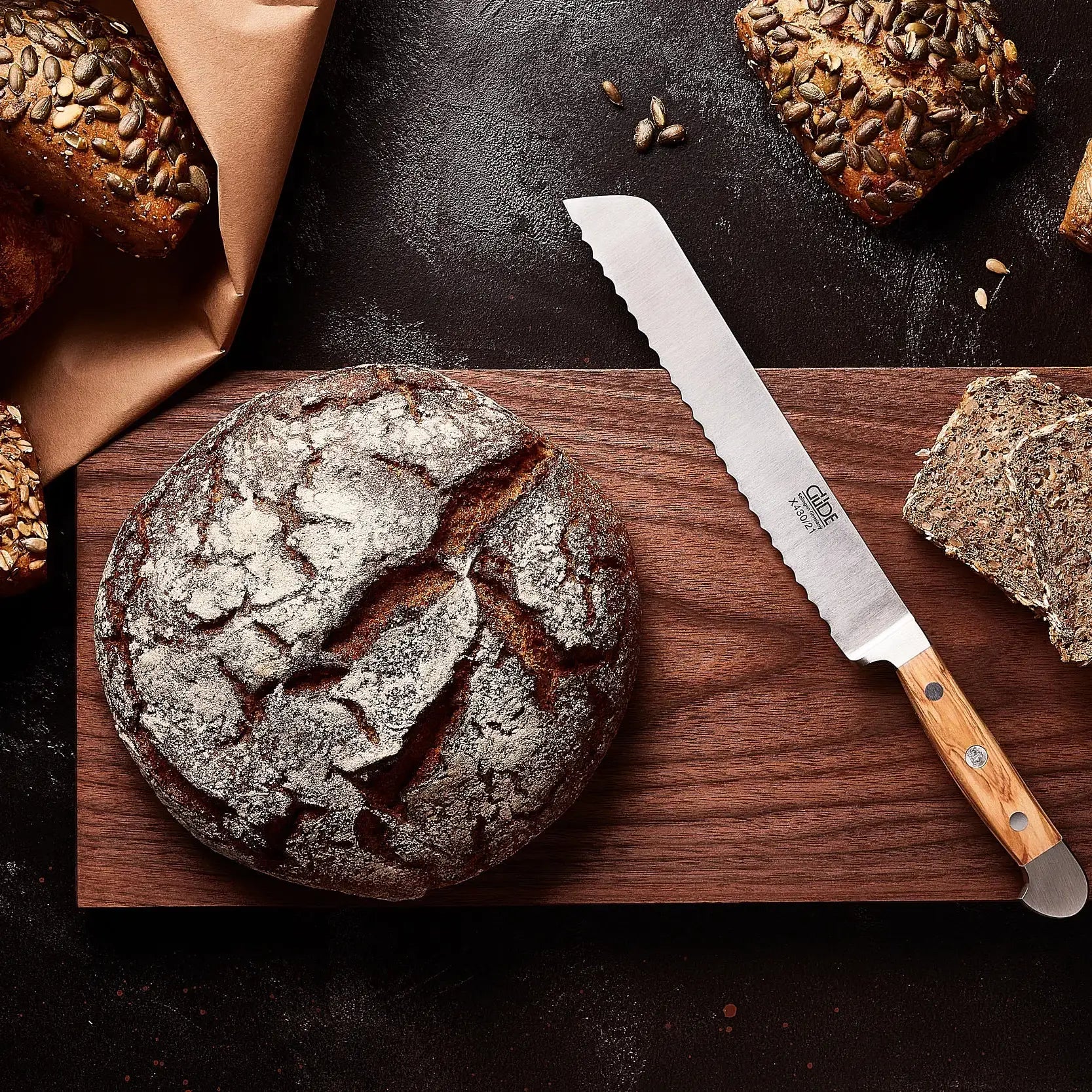
Le matériau du manche de The Knife est le bois d'olivier andalou — provenant d'oliveraies matures du sud de l'Espagne, sélectionné pour la qualité de son grain avant d'être façonné et rivé à l'acier plein tang. Le bois d'olivier est l'un des bois durs les plus stables dimensionnellement pour un usage en manche : sa teneur naturelle en huile le rend résistant à l'absorption d'humidité, il ne se déforme ni ne se fissure sous les variations thermiques d'une cuisine active, et sa densité lui confère un poids satisfaisant.
La variation visuelle du bois d'olivier — l'interaction de grains d'or, d'ambre et de brun profond — fait qu'aucun manche n'est identique à un autre. Le couteau que vous achetez est le seul au monde à posséder exactement ce manche. À une époque de production de masse, ce caractère individuel est véritablement rare pour un outil de cuisine.
The Knife se distingue par trois éléments inhabituels même parmi les couteaux allemands haut de gamme : son forgeage en une seule pièce (la lame et le talon proviennent de la même barre d'acier, sans jointure), son système d'équilibre calibré qui répartit le poids entre la lame, le talon et le manche pour que le couteau semble neutre en main, et son tranchant meulé à la main — fini par un artisan plutôt que par une machine. La plupart des couteaux de production, même haut de gamme, utilisent un meulage automatisé pour la constance. Les tranchants meulés à la main de GÜDE présentent des variations mineures que les cuisiniers expérimentés peuvent ressentir.
Oui. Ginza Steel est un détaillant autorisé de GÜDE Solingen au Canada, proposant la collection complète Alpha Olive, y compris The Knife en 8″ et 10″, ainsi que des couteaux à pain et des lames spécialisées. Les commandes de 99 $ CA ou plus sont livrées gratuitement au Canada ; les commandes vers les États-Unis sont livrées gratuitement dès 120 $ CA.
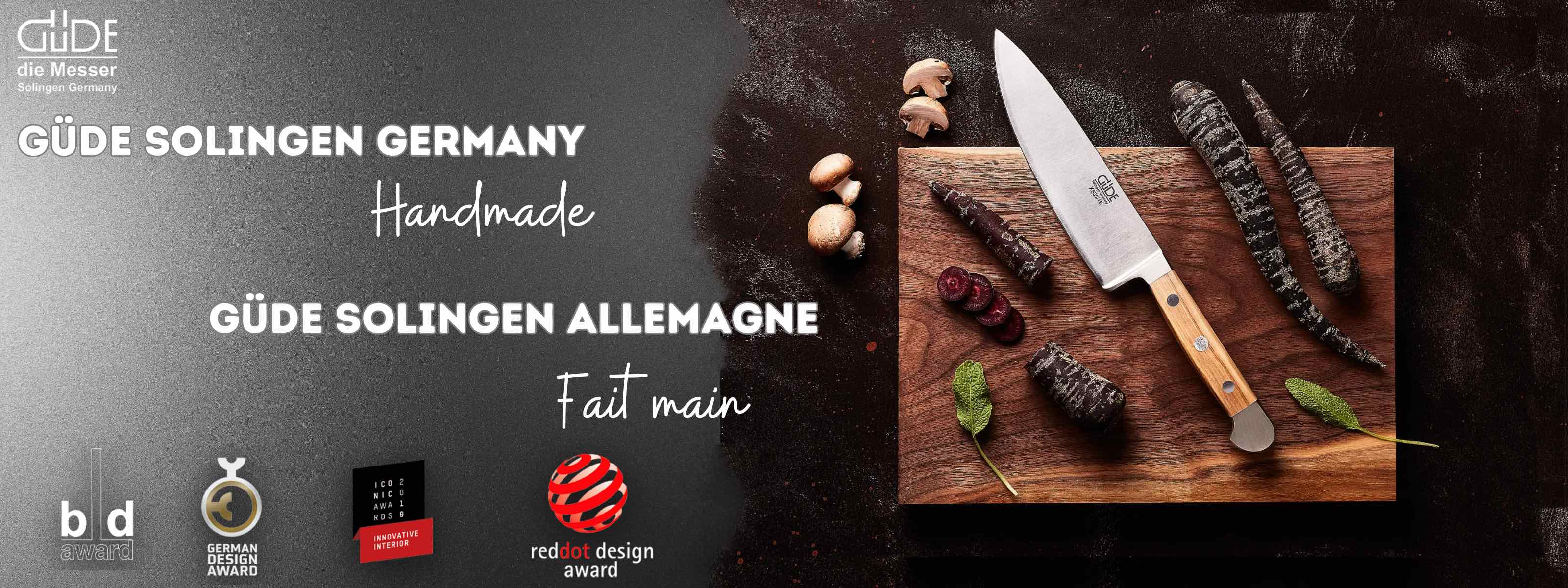
The Knife a reçu quatre prix internationaux de design et de qualité : le Red Dot Award pour le design de produit, le iF Design Award de l'International Forum Design en Allemagne, le Good Design Award du Chicago Athenaeum, et le Plus X Award pour l'innovation, la qualité et le design. Ces prix reconnaissent à la fois la performance fonctionnelle et le design industriel du couteau en tant qu'objet.
Lavage à la main uniquement — jamais au lave-vaisselle. Les cycles de chaleur et les détergents agressifs du lave-vaisselle assèchent et fissurent les manches en bois d'olivier et accélèrent l'oxydation de l'acier à la jonction du talon. Lavez à l'eau tiède avec un savon doux, séchez immédiatement avec un chiffon, et rangez dans un bloc à couteaux ou sur une bande magnétique. Une application occasionnelle d'huile minérale alimentaire ou de cire d'abeille sur le manche nourrira le bois et prolongera considérablement sa durée de vie.
Chaque couteau GÜDE est forgé et fini à la main à Solingen, en Allemagne — la même ville, et dans certains cas le même atelier familial, que lors de la fondation de l'entreprise en 1910. Solingen est la capitale allemande de la coutellerie depuis plus de 700 ans. La désignation « Solingen » sur une lame est une indication géographique protégée par la loi allemande, ce qui signifie qu'elle ne peut être utilisée que par des couteaux véritablement fabriqués là-bas.
L'acier Cr-Mo-V de GÜDE à environ 57 HRC est plus tendre que les aciers japonais haut de gamme comme le VG10 (60–61 HRC) ou le SG2/R2 (62–64 HRC). La différence pratique : le tranchant GÜDE est plus facile à restaurer sur un fusil à aiguiser ou une pierre à aiguiser et plus résistant à l'ébréchure sous contrainte latérale. Les aciers japonais conservent leur tranchant plus longtemps entre deux affûtages mais exigent une technique plus soignée et tolèrent moins bien les chocs violents. Le GÜDE est le meilleur choix pour un cuisinier qui veut un cheval de bataille — un couteau qu'il peut utiliser sur tout et affûter facilement. Les aciers japonais à haute dureté récompensent une technique précise et maîtrisée.