Article: Tsubazo Knives: Affordable Japanese Kitchen Knives Made in Japan (Complete Guide)
Tsubazo Knives: Affordable Japanese Kitchen Knives Made in Japan (Complete Guide)
Tsubazo knives are proof that a genuine Japanese kitchen knife does not have to cost a fortune. Made in Japan with stainless steel blades and comfortable wood handles, Tsubazo knives give home cooks and busy restaurant kitchens an authentic Japanese blade shape and build at an everyday price. In this guide we cover the full Tsubazo lineup, which knife suits which job, and the one thing every new owner should know: a few minutes on a whetstone turns a good Tsubazo knife into a great one.
What Are Tsubazo Knives?
Tsubazo is a Japanese knife line built around the classic shapes Japanese cooks use every day: the Santoku, the Gyuto and the Nakiri, plus a Petty knife for small tasks. Every Tsubazo knife is made in Japan with a stainless steel blade, so it resists rust and stains and suits daily use without special care. The wood handles are shaped for a secure, comfortable grip during long prep sessions.
Our customers keep coming back to Tsubazo for one reason: honest quality at a fair price. These are not collector pieces meant to sit in a display case. They are working Japanese knives that you can use hard, sharpen often and rely on for years.
The Tsubazo Lineup
Tsubazo Santoku 170mm

The Santoku is the all-rounder of the Japanese kitchen. Its name translates roughly to "three virtues", referring to slicing, dicing and mincing. The 170mm blade has a flat profile and a rounded tip, ideal for push cuts through vegetables, boneless proteins and herbs. If you only buy one Tsubazo knife, start here.
Shop the Tsubazo Santoku 170mm
Tsubazo Gyuto 180mm

The Gyuto is the Japanese chef's knife. Compared with the Santoku, it has a pointed tip and a gentle curve along the edge, so it handles rocking cuts, slicing meat and fish, and fine tip work. The 180mm length is easy to control on a standard home cutting board while still having enough reach for larger ingredients.
Tsubazo Nakiri 165mm

The Nakiri is a dedicated vegetable knife. Its straight, rectangular blade meets the board along its full length, giving clean, complete cuts through onions, cabbage, carrots and squash with a simple up-and-down motion. Vegetarian cooks and anyone who preps a lot of produce will love it.
Tsubazo Knife Sets
Two Piece Set: Santoku and Petty

A versatile starter pair. The Santoku handles the main prep work while the Petty knife takes care of peeling, trimming and small fruit. A great first Japanese knife set or a thoughtful gift.
Shop the Tsubazo Two Piece Set
Essential Duo Set: Gyuto and Nakiri

The Gyuto for meat, fish and general work, the Nakiri for vegetables. Together they cover nearly every cutting task in a home kitchen.
Shop the Tsubazo Essential Duo Set
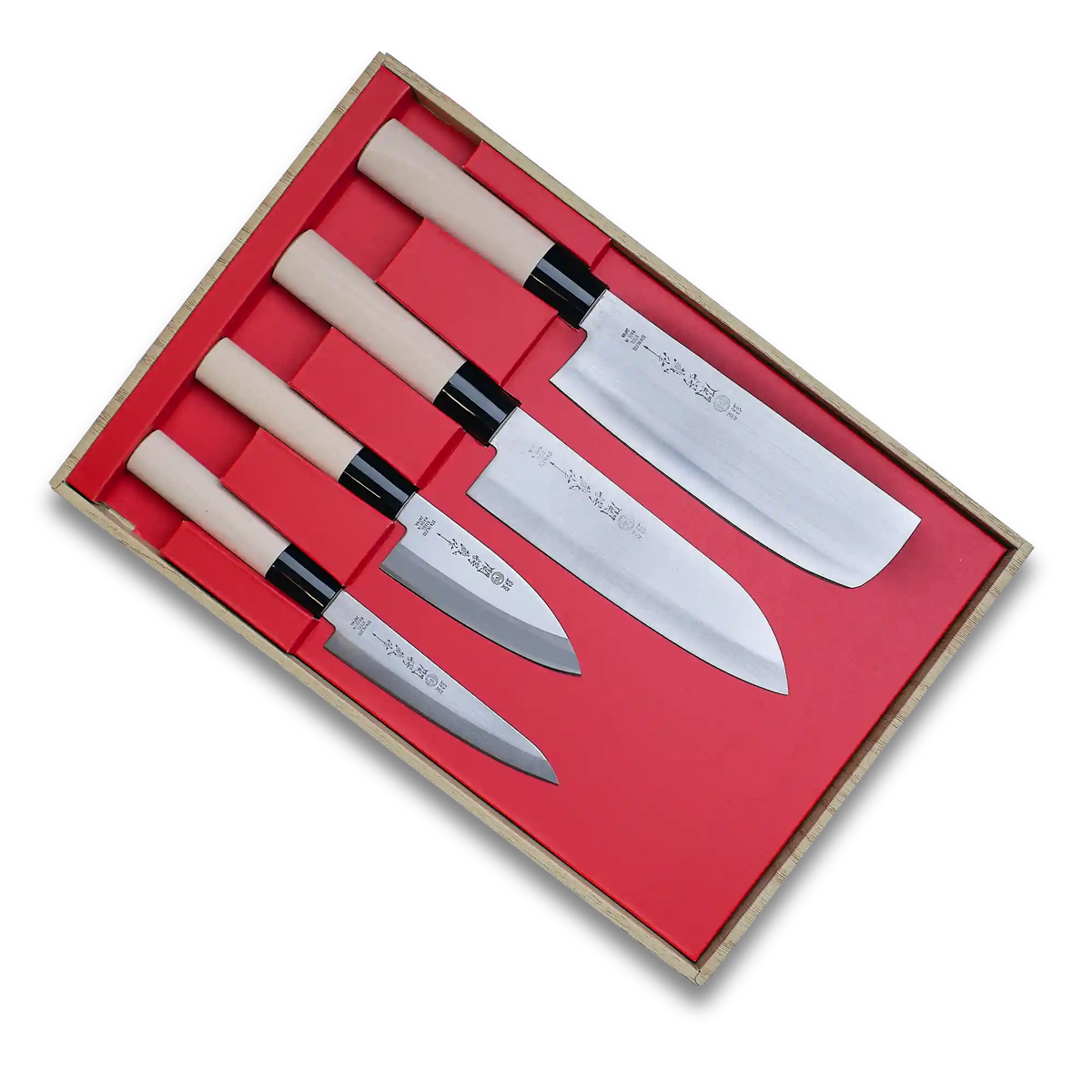
Four Piece Set: The Complete Kitchen

Santoku 170mm, Gyuto 180mm, Nakiri 165mm and Petty 120mm. Every core Japanese shape in one set, at a price that is hard to beat for made-in-Japan knives.
Shop the Tsubazo Four Piece Set
Restaurant Bundle: Six Gyuto 180mm

Built for commercial kitchens. Six matching Gyuto knives let you equip a full line with consistent, easy-to-maintain Japanese blades, without the cost of premium knives that can go missing or get damaged in a busy service.
Shop the Tsubazo Restaurant Bundle
About the Factory Edge: Sharpen for Best Results
Here is what sets realistic expectations and keeps our customers happy. Tsubazo knives ship with a working factory edge. It is sharp enough for everyday use straight out of the box, but it is not a finished, hand-honed razor edge. That is one of the ways Tsubazo keeps the price accessible: the blade itself is well made in Japan, and the final edge is left to the owner.
The good news is that stainless steel Japanese blades like these respond very well to sharpening. One session on a whetstone brings out the real performance of the blade, and regular touch-ups keep it there. Read more about why Tsubazo is priced this way.
How to Sharpen Your Tsubazo Knife
- Soak or wet your whetstone. Follow the stone's instructions. A medium grit around #1000 is ideal for setting a new edge.
- Find your angle. Hold the blade at roughly 15 degrees to the stone. An angle guide, or two stacked coins under the spine, is a simple way to keep it steady.
- Sharpen the first side. Work from heel to tip with light, even pressure until you can feel a small burr along the opposite edge.
- Repeat on the other side. Match the number of strokes and raise a burr back to the first side.
- Refine and polish. Move to a finer stone such as #3000 to #6000 for a smoother, sharper edge, using lighter strokes.
- Remove the burr. Finish with a few alternating light strokes, or strop on leather or newspaper.
- Test. A properly sharpened Tsubazo knife should slice cleanly through paper or a ripe tomato skin without pressure.
Between sharpenings, a ceramic honing rod keeps the edge aligned. Most home cooks only need a full whetstone session every few months.
Sharpening Tools We Recommend
A combination 1000/6000 whetstone is all most Tsubazo owners need. Our King 1000/6000 whetstone is the best value starter stone, the KC Series diamond 1000/6000 cuts faster with a non-slip base, and the Mont Blanc Super Togeru angle guide clips onto the spine and holds a steady 15 degree angle, which makes it ideal for beginners. For honing rods, strops and more, browse the full range below.
Shop knife sharpening stones and tools →
Caring for Tsubazo Knives
- Hand wash and dry right away. Avoid the dishwasher, which dulls edges and damages wood handles.
- Use wood or soft plastic cutting boards. Glass, stone and ceramic boards dull any knife quickly.
- Avoid twisting through bones or frozen food. Japanese blades are designed for clean slicing, not prying.
- Store safely in a knife block, on a magnetic strip or with a blade guard to protect the edge.
Who Are Tsubazo Knives For?
- Home cooks who want their first real Japanese knife without a big investment.
- Learners who want an affordable blade to practise whetstone sharpening on.
- Restaurants and commercial kitchens that need reliable, matching knives across the line.
- Gift buyers looking for an authentic made-in-Japan gift at a sensible price.
Frequently Asked Questions
Are Tsubazo knives really made in Japan?
Yes. Every Tsubazo knife we carry is made in Japan.
Are Tsubazo knives sharp out of the box?
They arrive with a usable factory edge suitable for everyday cutting. For the sharpest possible result, we recommend sharpening on a whetstone when the knife is new.
What do I need to sharpen a Tsubazo knife?
A combination 1000/6000 whetstone, and optionally an angle guide. See our knife care and sharpening collection.
Are Tsubazo knives stainless steel?
Yes. All Tsubazo blades are stainless steel, which resists rust and is easy to care for.
Which Tsubazo knife should I buy first?
The Santoku 170mm is the best single all-purpose choice. If you want full coverage, the Four Piece Set includes every core shape.
Can I put Tsubazo knives in the dishwasher?
We do not recommend it. Hand washing and drying protects both the edge and the wood handle.
Do you sell Tsubazo knives wholesale for restaurants?
Yes. Our Restaurant Bundle includes six Gyuto knives, and we are happy to discuss larger quantities. Contact us for details.
Shop Tsubazo Knives in Canada
Tsubazo knives deliver what matters most: an authentic made-in-Japan blade, practical shapes and a price that makes sense for everyday cooking. Pair yours with a whetstone and you will have a Japanese knife that performs well above its price. Browse the full range at Ginza Steel and find the Tsubazo knife that fits your kitchen.